


Mental strength is about knowing what to let in, and just as critically, what to block out. It depends on creating boundaries where one is aware of the situations that are in control and can be dealt with by a specific action plan. Strong leaders know this and they stay focused on what they can manage, set boundaries, and lead with clarity and calm to enhance the productivity of their team and make better decisions without getting burned out.
In the race to transform healthcare with tech-enabled solutions, many founders and CEOs are burning out not because they lack drive, but because they have not learned to master one thing: Boundaries.
The Boundary Advantage
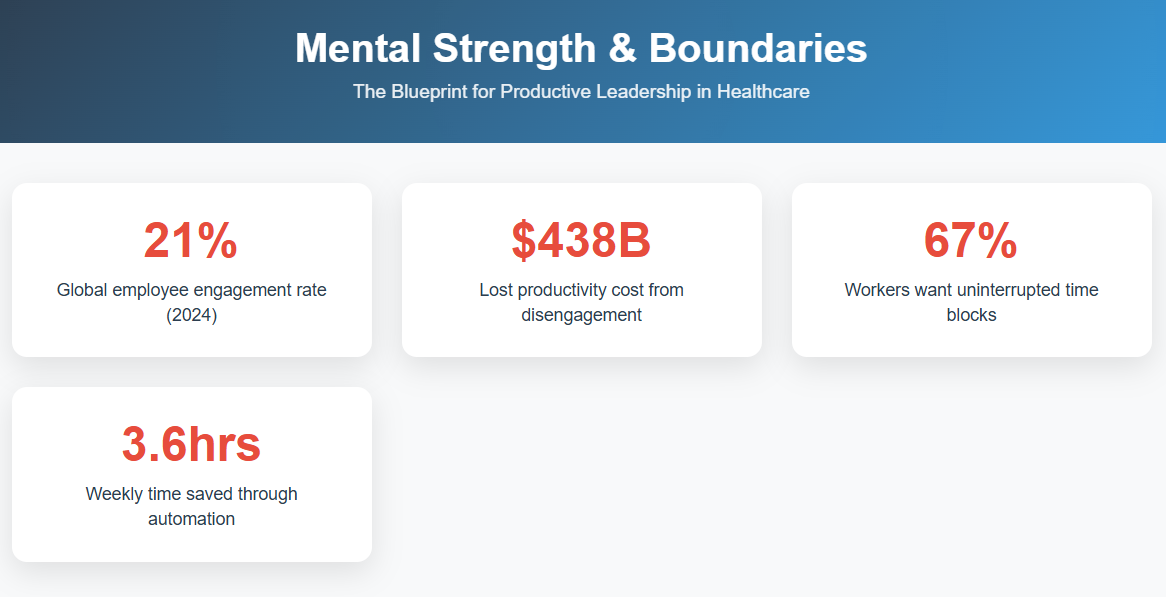
Recent data shows how urgent this shift in leadership is. Gallup’s State of the Global Workplace report (2024) revealed that global employee engagement declined to just 21%, with the steepest drop among managers. That disengagement carried a staggering cost—$438 billion in lost productivity last year alone.
This is not just about operational inefficiencies; it is a warning sign of mental depletion across leadership layers. While many executives double down on availability to prove their value, the most effective leaders are doing the opposite. They are learning to protect their focus, time, and energy like the strategic assets they are. Mental strength today is less about stamina and more about strategy (Coronado-Maldonado and Benítez-Márquez, 2023; Ruparel, 2020).
What Leaders Often Get Wrong
One of the most common misconceptions among leaders, and especially in healthcare and health IT, is that high availability equals high performance. Yet research proves otherwise.
According to Slack’s State of Work survey (2024), 67% of workers said predictable, uninterrupted blocks of time would significantly increase productivity. Those who actively use automation to streamline tasks save an average of 3.6 hours every week. That is nearly half a working day reclaimed not by working harder, but by protecting mental bandwidth.
The takeaway? The founders who are thriving are not just automating tasks; they are automating their decision-making around what gets their attention in the first place.
Strategic Thinking Beats Reactive Leadership
Mental strength shows up in subtle but powerful ways:
- Attending meetings that are aligned with strategic goals and declining those that do not require specific inputs.
- Investing time in deep work and thinking.
- Structuring the day around energy peaks, rather than letting meetings, emails and other people dictate your schedule.
- Declining investor calls or press interviews that do not align with current priorities.
This is not about being rigid. It is about being clear.
Imagine a fictional story of a VP at a high-growth healthtech firm who recently adopted a personal boundary of not responding to emails after 7 p.m. and declining meetings not tied to quarterly OKRs. The result? Not pushback, but recognition. She was promoted within six months.
This is not an anomaly. It is a pattern. Leaders who communicate and hold boundaries signal maturity, not resistance. Clear boundaries often lead to faster advancement because they reflect strategic clarity.
Boundaries Are Not Barriers
Boundaries are not about shunning people or being unavailable. They are about being deliberate, and they allow leaders to be present where it matters rather than spread thin across dozens of half-hearted efforts. The highest-performing leaders do not do more; they do what matters most, more consistently, and they build systems to support this clarity.
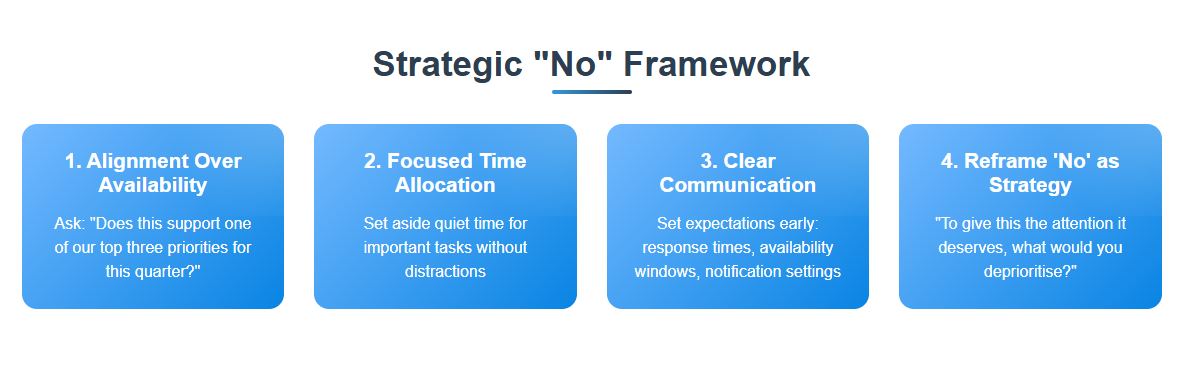
Consider the “Strategic No” Framework
This is not just a polite way of declining. It is a decision-making model built on alignment, value, and trust.
- Alignment Over Availability
Before accepting any new request or project, ask:
“Does this support one of our top three priorities for this quarter?”
If not, it is a no or a graceful redirection. - Allocate a Focused Time for Important Tasks
Leaders who set aside quiet time for important tasks without any distractions from meetings or messages consistently outperform. - Clear Communication
Set expectations early:- “Email responses within 24 hours”
- “Unavailable for meetings before 10 a.m.”
- “Slack notifications off during deep work blocks”
When teams know the rhythm, they learn to respect it and often adopt it.
- Reframing ‘No’ as Strategy
Instead of saying, “I cannot do that,” say:
“To give this project the attention it deserves, I would need to shift something else. What would you deprioritise?”
This shifts the conversation from resistance to resource allocation and an executive mindset.
The Myth of Work-Life Balance
Founders with strong boundaries do not aim for static balance. They aim for harmonious integration, a dynamic flow between execution, recovery, vision, and reflection.
That harmony depends on choices made daily.
- Do you take the investor call that interrupts your product strategy session?
- Do you stay online answering emails at 10:30 p.m., or recharge for tomorrow’s key hiring decision?
- Do you approve every cross-functional request, or channel team energy toward a singular strategic goal?
Every yes is an energy investment. Every no is a protection of your capacity. Mental strength lies in knowing which is which.
Why This Matters in Digital Health
In no other industry is the mission more personal. Health tech leaders are building systems that will shape patient lives, clinical workflows, and the future of care delivery. That level of responsibility demands clarity, rather than scattered urgency and reactive leadership. Digital health founders or any leader, for that matter, have an obligation to their teams, their clients, and themselves to operate from a place of grounded mental strength.
A New Kind of Leadership
Traditional leadership models rewarded visibility by being in every room, on every thread, cc’d on every email. The new model rewards discernment.
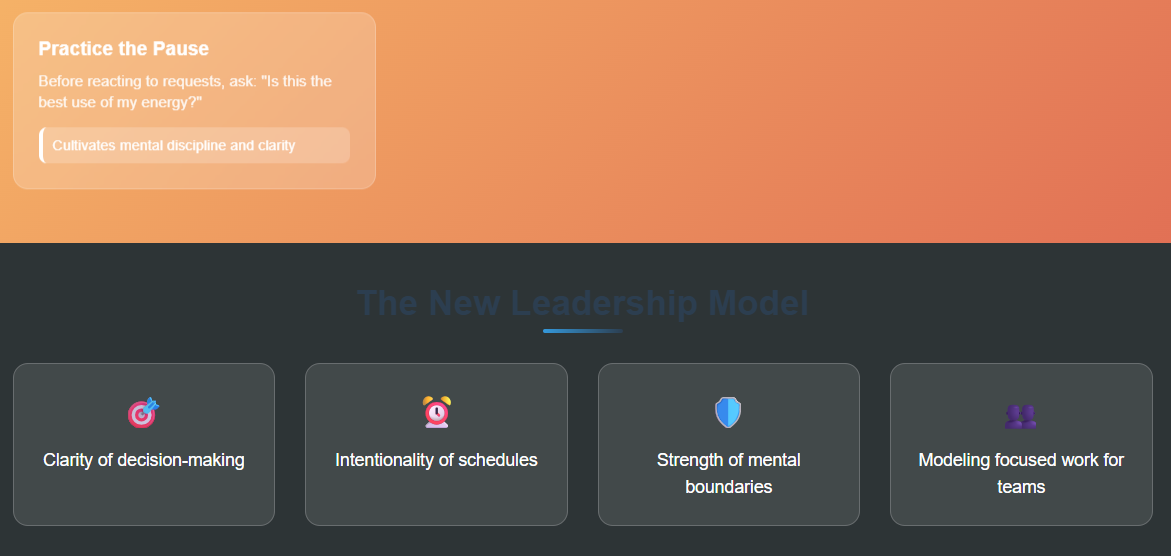
Leaders are now valued for:
- The clarity of their decision-making.
- The intentionality of their schedules.
- The strength of their mental boundaries.
Perhaps most importantly, for modelling to their teams that it is okay to focus deeply and say no deliberately.
Actionable Cheat sheet: Building Mental Strength & Boundaries for C-Suites in Digital Health
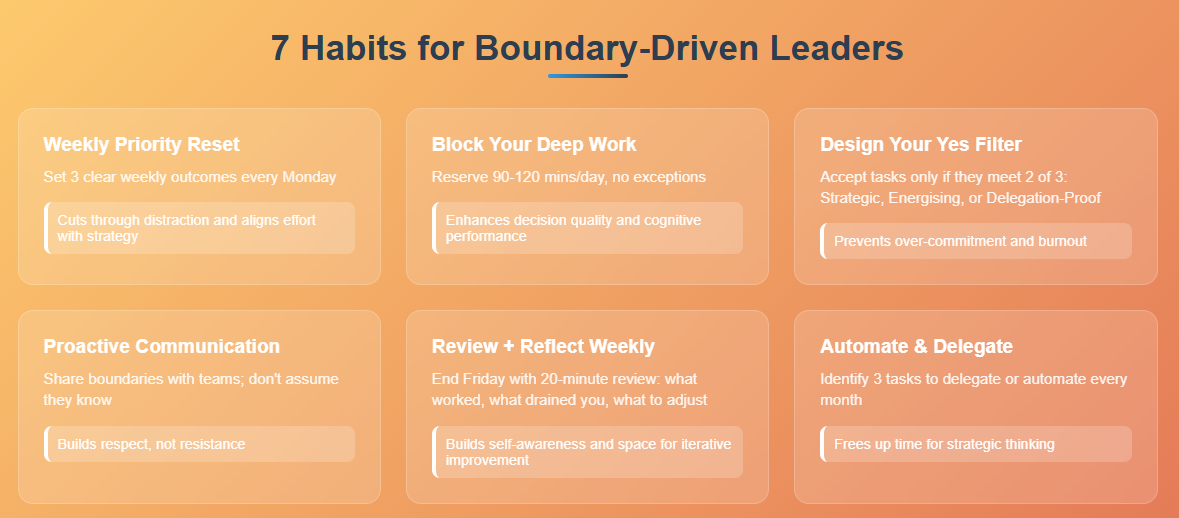
Here is a practical guide founders can use to build their own “Boundary Operating System.”
|
HABIT |
ACTION |
OUTCOME |
| Weekly Priority Reset | Set 3 clear weekly outcomes every Monday. | Cuts through distraction and aligns effort with strategy. |
| Block Your Deep Work | Reserve at least 90–120 mins/day, no exceptions. | Enhances decision quality and cognitive performance. |
| Design Your Yes Filter | Accept tasks only if they meet 2 of 3: Strategic, Energising, or Delegation-Proof. | Prevents over-commitment and burnout. |
| Proactive Communication | Share boundaries with teams; do not assume they know. | Builds respect, not resistance. |
| Review + Reflect Weekly | End Friday with a 20-minute review: what worked, what drained you, what to adjust. | Builds self-awareness and space for iterative improvement. |
| Automate & Delegate | Identify 3 tasks to delegate or automate every month. | Frees up time for strategic thinking. |
| Practice the Pause | Before reacting to a request, pause and ask: “Is this the best use of my energy?” | Cultivates mental discipline and clarity. |
The mental strength to stay focused and calm by setting boundaries improves productivity.

References
- Coronado-Maldonado, I., Benítez-Márquez, M.-D., 2023. Emotional intelligence, leadership, and work teams: A hybrid literature review. Heliyon 9, e20356. https://doi.org/10.1016/j.heliyon.2023.e20356
- Ruparel, N., 2020. Mental toughness: Promising new paradigms for the workplace. Cogent Psychol. 7. https://doi.org/10.1080/23311908.2020.1722354