
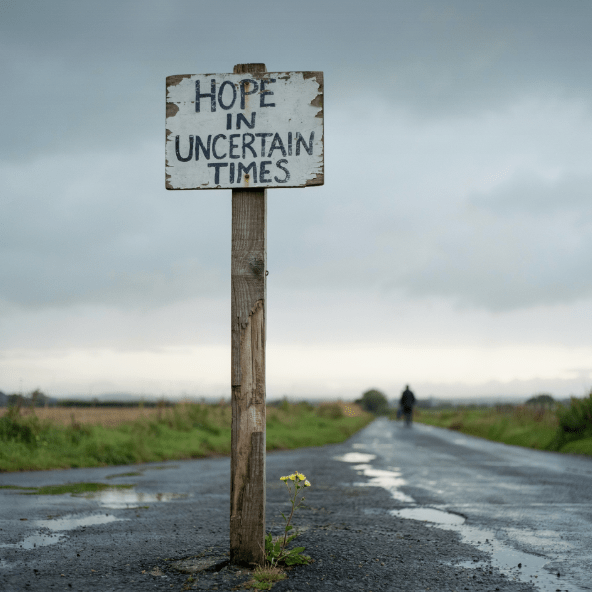

Introduction
Hope is frequently discussed in terms of moods, in which case some individuals are full of it, others have lost it, and everyone else is advised to look on the bright side. Such understanding of hope is not particularly useful when the level of uncertainty is high.
A delayed project, an insecure job market, a health problem, or any disruptive changes in technologies cannot be addressed with optimism alone. One might know that there is always a chance that things will get better, but remain unable to envision future actions.
Hope psychology offers a more pragmatic approach to dealing with such situations. In accordance with Snyder’s hope theory, psychological hope is based on two related concepts: agency – the awareness of our capability to reach the goal; and pathways – the ability to identify several routes to action (Snyder, 2002). No specific outcome has to be seen as the necessary result of the situation, but having a goal and at least one realistic pathway is essential.
Cultivating hope in uncertain times involves accepting reality rather than dismissing it.
Hope Is More Useful When It Has a TargetBuilding Mental Resilience in the Workplace – A Practical Guide for Teams and Leaders
Uncertainty tends to generate highly expansive thoughts such as “My career is stagnant,” “Everything is changing,” or “I don’t know what will happen.” Though understandable, these thoughts are too expansive to form a framework for action.
An actionable goal provides a smaller space for movement. The thought “I need to increase my sense of security” could be converted into something like, “In the coming month, I will revise my portfolio and reach out to two people who are working at jobs that I’m looking for.” The goal does not solve everything. It shapes the future for the coming weeks.
Separating results from processes can also make the process easier. Whether the employer decides to conduct the interview, whether the funding application gets approved, or whether the proposal receives acceptance – these are all beyond our control. However, we do control whether we submit the proposal with care, present our findings effectively, and ask for feedback prior to deadlines.
Cultivating hope in uncertain times is easier with action-oriented goals that are still open.
One Route Is Rarely Enough
A single plan can feel reassuring until it fails. Then, the blocked route can easily be mistaken for a blocked future.
The pathway approach begins by asking another question: What does the individual really want, and whether the other pathway serves the same purpose? An employee unable to access a formal position this year can lead an internal project, provide guidance to a peer, engage in targeted learning, or demonstrate progress through measurable achievements.
The pathways are not always of equal worth, nor do they need to be offered as compensation. The strength of the alternative is in its ability to allow action. A roadblock is still significant but no longer a defining factor in the process.
A useful activity is to map out one objective, three potential pathways, and an associated obstruction. One can then list out solutions to each roadblock. This process might seem rather basic; yet, it transforms ambiguity from one barrier to a succession of choices.
Agency Grows from Evidence, Not Slogans
During a difficult period, telling yourself “I can do this” may not feel convincing. Agency is easier to believe when it is built from small pieces of evidence.
That evidence might be an email sent, an appointment booked, a section drafted, or a question asked in a meeting. None of these actions proves that the final outcome will be positive. They prove something more modest and often more useful: you are still able to influence the next part of the process.
At the end of the day, it can help to record three short points: what was moved forward, what obstacles were handled, and what the next step is. This is not about turning hope into a productivity system, but noticing movement that anxiety tends to ignore.
Case Study: A Project Put on Hold
Priya was organizing the collaboration between a healthcare technology company and the local clinic as a pilot program. After four months of preparatory work, the project was put on hold during a funding review. There were no new dates for its launch, and the continuation of this process remained uncertain.
To begin with, Priya considered the project a failure. She refused to open the folder and ask for the progress, because every talk made her more sure of the ineffectiveness of the project.
In the supervision session, Priya was required to formulate the objective that is under the deadline date. And this objective did not include only the launching of a pilot in July, but the achievement of work experience in managing a healthcare-related digital project and building relations with healthcare organizations.
Once the purpose became clear, other routes opened up to Priya. She could talk to clinic staff about the implementation process, refine the evaluation strategy, or help with another internal project that also needed the same sort of coordination skills. She decided on the interviews, which would serve the project regardless of its ultimate fate.
Priya had a very modest aim: connect with two stakeholder contacts and distill one piece of insight each week. Her colleague offered to go through her notes with her at the end of each week. The fate of the funding was uncertain for several weeks, but Priya stopped feeling totally paralyzed. She was doing good work, keeping her network alive, and gaining experience that could be used in future application processes.
None of this meant that the case forced her into pretending everything was rosy. All she needed was a new purpose, a path, and some sign that action was possible.
Hope Is Often Social
While hope is often discussed in terms of a personal outlook, we often get insight into possible solutions from others that we would be hard-pressed to conceive of on our own. They might offer us relevant data, practical assistance, feedback, or simply an alternative perspective that is less negative.
What we ask for is important. “I don’t know what to do” might elicit an overly general response. What is more helpful is asking for specifics, such as “Do you have any ideas for two other ways forward?” or “Can you please follow up with me next week to find out whether I made the call?”
To whom we turn is also relevant. While some become directive in the face of ambiguity or force positive thinking, others can listen thoughtfully, pose questions, and help point out possibilities without minimizing the problem.
Assistance doesn’t take away autonomy; rather, it often enables it.
Difficult Feelings Do Not Cancel Hope
However, it should be said that hope does not mean the lack of fear, disappointments, or grief. These feelings can sometimes reflect a person’s sincere reaction to what has happened. Their hasty replacement can cause a perception of hope as something artificial. Thus, a much more realistic strategy is to acknowledge the two simultaneous facts, for instance: “I feel disappointed, but I can choose how to act further.” Or “It is unknown how this story ends, and I can get ready for the upcoming stage.”
The relationship of hope to well-being has usually been demonstrated positively in research (Weis & Speridakos, 2011). Moreover, hope-related interventions have shown modest benefits across clinical and community settings. This evidence does not imply that hope will bring the expected results in every situation. It suggests that hope can support action aimed at achieving one’s goals. Sometimes the most hopeful response is to rest, ask for help, or accept that a goal needs to change.
A Short Practice for Uncertain Days
If the future seems overwhelming, try asking yourself these five questions to scale it down to a manageable level:
- What really matters in this situation?
- What one realistic step can be taken?
- If that step doesn’t work, what is a different approach?
- What can I do right now, today, in the next 24 hours?
- Who might help with information, inspiration, or accountability?
It’s an exercise meant to remain small. It is simpler to cultivate hope in uncertain times through the next step than the whole uncertain future ahead.
When Hope Feels Unavailable
Sometimes planning isn’t enough. When hopelessness, withdrawal, or suicidal thoughts persist, then the need for more than just a wellbeing plan arises. It’s important to talk to a professional with the relevant qualifications, a general practitioner, or someone whom you trust.
Hope shouldn’t become yet another obligation for someone who’s suffering. Getting help doesn’t mean hope has been lost; it could be a key component of the hope itself.
Conclusion
Creating hope in uncertain situations does not require one to see a favorable outcome at the end. Creating enough framework to keep moving forward when the outcome is still unseen will do.
Having a goal gives you something to work towards. Multiple options decrease the impact of one failure. Taking action restores your sense of control, while good relations make the task less lonely. Nothing takes away the uncertainty, but it shifts your starting point for facing it.
Cultivating hope in uncertain times does not guarantee everything will work out. It gives you a compelling reason to move forward, nevertheless.
References
- Chan, K., Wong, F. K. Y., & Lee, P. H. (2019). A brief hope intervention to increase hope level and improve well-being in rehabilitating cancer patients: A feasibility test. SAGE Open Nursing, 5, 1–13. https://doi.org/10.1177/2377960819844381
- Snyder, C. R. (2002). Hope theory: Rainbows in the mind. Psychological Inquiry, 13(4), 249–275. https://doi.org/10.1207/S15327965PLI1304_01
- Weis, R., & Speridakos, E. C. (2011). A meta-analysis of hope enhancement strategies in clinical and community settings. Psychology of Well-Being: Theory, Research and Practice, 1, Article 5. https://doi.org/10.1186/2211-1522-1-5