

Introduction
Finland has led global happiness rankings since 2018, driven by strong social support, trust, and welfare policies. This report analyses how core positive psychology principles – such as the PERMA model (Positive emotions, Engagement, Relationships, Meaning, Accomplishment), gratitude, resilience, and social connectedness – align with Finland’s outcomes. We review recent peer‑reviewed research and official data (World Happiness Report, Organisation for Economic Co-operation and Development, Finnish ministries) to connect theory with Finnish practice. Key findings show that Finland’s egalitarian policies, nature-based culture, and emphasis on community effectively foster positive emotions and meaning (supporting PERMA), while Finnish concepts like sisu (resilience) bolster well-being. The analysis also examines critiques (e.g., rising youth loneliness) and acknowledges limitations. Evidence is drawn from recent studies (2019–2026) and official sources.
Finland’s Top Happiness Rankings
According to the World Happiness Report, Finland has consistently ranked #1 globally for happiness consistently since 2018. In 2025, Finland’s average life-satisfaction score was 7.736 (out of 10), slightly above Denmark (7.521), Iceland (7.515), Sweden (7.345), and the Netherlands (7.306). An OECD working paper (Apr 2026) notes Finland’s overall strong well-being but flags growing issues for younger cohorts: rising unemployment and declining subjective well-being since 2018, and increasing loneliness across ages. This underscores that even highly ranked countries face challenges.
Table 1. Happiness metrics (2025) for Finland and peers. Metrics are the WHR life-satisfaction score and key contributing factors (log GDP, social support, healthy life expectancy, freedom, generosity, and low corruption).
| Country | Rank | Score | GDP | Social | Life | Free | Gen | Corr |
| Finland | 1 | 7.736 | 1.749 | 1.783 | 0.824 | 0.986 | 0.110 | 0.502 |
| Denmark | 2 | 7.521 | 1.825 | 1.748 | 0.820 | 0.955 | 0.150 | 0.488 |
| Sweden | 4 | 7.345 | 1.783 | 1.698 | 0.889 | 0.952 | 0.170 | 0.467 |
| Netherlands | 5 | 7.306 | 1.822 | 1.667 | 0.844 | 0.860 | 0.186 | 0.344 |
(Source: World Happiness Report 2025)
Finnish Well-Being Policies and Culture
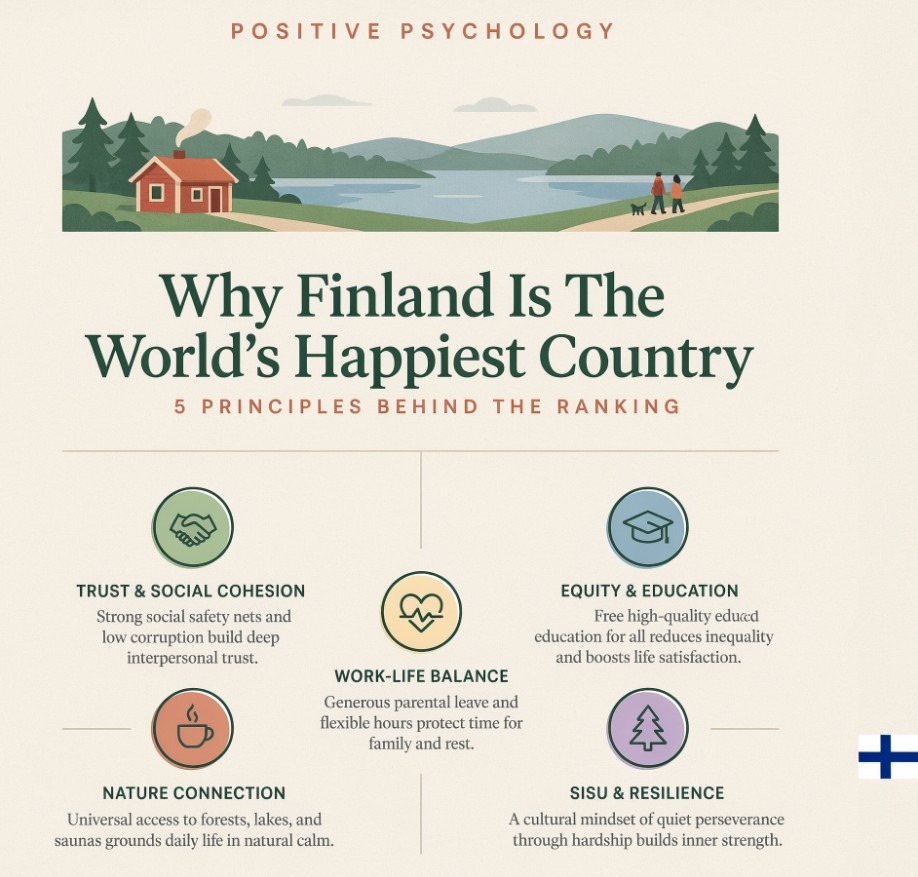
Finland’s success is supported by explicit “well-being economy” policies. In 2023, the government launched a National Action Plan for the Economy of Wellbeing (2023–25) to integrate well-being into governance. Finland has long used broad indicators (“Findicator”, 2009–2022) to track societal welfare. Key policy strengths include universal healthcare and education, generous parental leave, low inequality, and access to nature (every resident has the right to roam publicly-owned lands). These create conditions for positive emotions and social support, aligning with positive psychology tenets that external conditions (socio-economic and environmental) shape well-being. For example, Finnish schools emphasize outdoor education and student autonomy, fostering engagement and connection to nature – a source of well-being for many Finns. The Finnish Institute for Health and Welfare (THL) reports that leisure in nature and family contact strongly boost well-being (see next section). Welfare policies also reduce stress: universal basic services mean citizens spend less energy on survival, freeing mental resources for positive experiences.
Core Positive Psychology Principles
Positive psychology, defined as the scientific study of what makes life most worth living, identifies key components that can explain national happiness. The PERMA model (Seligman, 2011) specifies five elements: Positive motions, Engagement, Relationships, Meaning, and Accomplishment. Finland’s context is rich in each:
- Positive Emotions (P): High trust in society and good governance translates to daily feelings of security and happiness. Studies show that generous welfare and social trust (common in Nordic countries) increase life satisfaction. Finland also promotes gratitude and mindfulness in schools and workplaces, which international research shows can increase positive affect (though direct Finnish evidence is limited).
- Engagement (E): Finns report strong engagement with work, education, and hobbies. The culture of “sisu” (resilient grit) means Finns persist through challenges, often finding flow in activities despite adversity. For example, a 2024 study found that beneficial sisu significantly enhances mental health and satisfaction. This state of focused effort supports engagement and achievement.
- Relationships (R): Social support is a major driver of Finnish well-being. [Pasanen et al. 2021] found that among Finns living alone, having close friends and family predicts better mental health, more than socio-economic factors. Finland has strong community ties: most citizens know neighbors, volunteer rates are high, and trust levels exceed those of most countries. Social capital surveys confirm that Finland’s network strength correlates with happiness.
- Meaning (M): Finns find meaning in work and nature. The education system stresses purposeful learning, and many Finns describe a life philosophy tied to nature (forest visits, wilderness retreats). A qualitative study of adolescents found 67% explicitly linked nature to happiness. This “biophilia” provides a sense of purpose and calm, consistent with eudaimonic well-being.
- Accomplishment (A): Higher education and achievement are valued. Finland’s world-class schools and innovation sector let individuals set and meet goals, boosting self-efficacy. National pride (Nokia era, tech startups) may also feed collective accomplishment. Achieving benchmarks like narrow income gaps and longevity (Finland’s healthy life expectancy factor) further satisfies cultural goals.
In sum, Finnish society supports each PERMA element: secure living boosts positive affect, vibrant social networks give belonging, and culturally valued resilience and nature engagement infuse life with meaning. Fig.1 (below) summarizes research milestones linking these principles to Finland’s well-being:
Evidence from Recent Studies
Several recent studies underpin these links. Pasanen et al. (2021) used survey data to show that, among Finnish adults living alone, social and functional factors (number of friends, being partnered) strongly predict positive mental health. In their structural model, contact with family/friends and outdoor physical activity mediated these effects. This suggests that Finland’s emphasis on community and nature (ingrained in policy and lifestyle) tangibly increases subjective well-being. Likewise, Tanaka and Tokimatsu (2020) surveyed Finns and found that social capital (measured via personal networks) correlates with happiness. Their cross-country analysis highlighted Finland as one of the nations (with Denmark and Japan) where network resources most strongly boost life satisfaction.
Resilience research adds another layer. The Finnish trait of sisu – extraordinary perseverance – has been operationalized in surveys. Khan et al. (2024) report that beneficial sisu (adaptive persistence) “contributes significantly to mental and physical health, satisfaction, and professional accomplishments”. In contrast, “harmful sisu” (overbearing persistence) harms well-being. This dual nature underscores how a positive-psychology element (resilience) can explain Finland’s high coping ability, while cautioning against burnout.
Nature connection also emerges. Finnish studies find that time outdoors reduces stress and fosters joy. In one study of 15–16-year-olds in Lahti, two-thirds explicitly wrote that nature makes them happy, noting that forests and lakes were “calming and peaceful, improving [their] mood and relieving stress”. This aligns with the concept of meaning and positive emotion through biophilia.
At the policy level, the OECD (2026) highlights a generational gap: older Finns report very high well-being, whereas younger Finns face declining life satisfaction and performance. This warns that positive psychology elements are not uniform; e.g., younger people may feel less connected or have more mental health issues, indicating limits to the Finnish model. Even with Finland’s strengths, rising loneliness “since 2018” is noted for all ages, suggesting that social connectedness – a core R in PERMA – needs ongoing support.
Critiques and Limitations
While positive psychology principles provide insight, there are caveats. Critics note that focusing on happiness metrics can overlook inequality or mental illness. For example, Finland’s average score hides subgroups (youth, immigrants) with lower well-being. The OECD also reports that Finland’s youth have rising unemployment and lower PISA scores, which may not align with global happiness leaders. Furthermore, cultural differences mean positive psychology interventions (like gratitude journaling) validated in one context may not directly translate. The Finnish concept of sisu itself was once considered culture-specific; recent work suggests the sisu scale works internationally, but its application to policy requires nuance.
Another limitation is that high happiness can breed complacency: one article provocatively asked why Finns are “not happy about being the happiest” (McKinnon, 2018), implying that rankings alone may not capture lived experience. Also, the WHR’s single-question life evaluation captures cognitive satisfaction but only indirectly measures emotions and meaning. Thus, linking country-level scores to individual positive psychology must be done carefully.
Finally, positive psychology focuses on individual factors (attitudes, relationships) but often underplays structural issues. While Finland’s egalitarian policies drive many positive effects, an overemphasis on “personal positive attitude” could downplay the importance of government welfare programs. The OECD’s Economy of Wellbeing approach counters this by institutionalizing well-being at all levels, but success depends on policy implementation.
Conclusions
Finland’s global happiness leadership illustrates how positive psychology principles can manifest at a national level. Evidence suggests that trust, social support, meaningful engagement, and culturally valued resilience (sisu) create a fertile ground for PERMA elements. Finnish policies – from universal education and healthcare to nature access – complement these principles by providing security, purpose, and belonging. However, challenges remain: the well-being of younger Finns and those on society’s margins is more fragile, reminding us that even the happiest countries must continually reinforce social connections and mental health support.
Frequently Asked Questions (FAQs)
- What are positive psychology principles, and why are they important?
Positive psychology principles are evidence-based concepts that help people thrive by promoting strengths, resilience, positive emotions, meaningful relationships, purpose, and achievement. Martin Seligman’s PERMA model is one of the best-known frameworks. These principles are important because research shows they improve mental wellbeing, life satisfaction, and overall quality of life at both individual and societal levels.
- Why is Finland consistently ranked as the happiest country in the world?
Finland consistently tops the World Happiness Report because of its strong social support systems, high levels of trust, excellent public services, low corruption, access to nature, and emphasis on equality. These factors closely reflect positive psychology principles by creating an environment that supports positive emotions, meaningful relationships, resilience, and a strong sense of purpose.
- How does the PERMA model explain Finland’s happiness?
The PERMA model explains wellbeing through five elements: Positive Emotions, Engagement, Relationships, Meaning, and Accomplishment. Finland performs well across each of these dimensions through its education system, welfare policies, community trust, outdoor lifestyle, and culture of resilience, helping citizens experience higher overall life satisfaction.
- What role does nature play in positive psychology principles?
Nature is an important contributor to wellbeing within positive psychology. Research from Finland shows that spending time in forests, parks, and natural environments reduces stress, improves mood, strengthens resilience, and enhances feelings of meaning and connectedness. Regular contact with nature is associated with better mental health and higher life satisfaction.
- Can other countries apply Finland’s positive psychology principles?
Yes, although Finland’s success is supported by unique cultural and policy factors, many positive psychology principles can be adapted elsewhere. Encouraging stronger social connections, investing in mental health, improving access to green spaces, promoting gratitude and resilience, and creating supportive communities are evidence-based strategies that can help improve wellbeing across different societies.
References
- World Happiness Report 2025; Helliwell, J. F., Layard, R., Sachs, J. D., De Neve, J.-E., Aknin, L. B., & Wang, S. (Eds.). (2025). World Happiness Report 2025. Sustainable Development Solutions Network. https://worldhappiness.report/
- Hakokangas, E., & Puhakka, R. (2021). Nature and happiness: Finnish adolescents’ perceptions of the relationship between nature and wellbeing. Children, Youth and Environments. https://research.childrenandnature.org/
- Khan, M. A., et al. (2024). Understanding the impact of sisu on workforce and well-being: A machine learning–based analysis. Heliyon, 10(2), e24193. https://doi.org/10.1016/j.heliyon.2024.e24193
- OECD. (2026). Well-being along the life course in Finland. OECD Publishing. https://www.oecd.org/
- OECD. (2024). Finland’s National Action Plan for the Economy of Wellbeing (2023–2025) and related initiatives. OECD Publishing. https://www.oecd.org/
- Pasanen, T., Tamminen, N., Martelin, T., Mankinen, K., Solin, P., & Suvisaari, J. (2021). Positive mental health of Finnish people living alone: The role of circumstantial factors and leisure-time activities. International Journal of Environmental Research and Public Health, 18(13), 6735. https://doi.org/10.3390/ijerph18136735
- University of Helsinki. (2024). Positive psychology: Study with Strength. https://www.helsinki.fi/en/projects/study-strength/positive-psychology
- Seligman, M. E. P. (2011). Flourish: A visionary new understanding of happiness and well-being. Free Press.
- Tanaka, K., & Tokimatsu, K. (2020). Social capital, subjective well-being, and happiness: Evidence from a survey in various European and Asian countries to address the Stiglitz Report. Theoretical Economics Letters, 10(1), 1–22. https://doi.org/10.4236/tel.2020.101001
- Csikszentmihalyi, M. (1990). Flow: The psychology of optimal experience. Harper & Row.
- Fredrickson, B. L. (2001). The role of positive emotions in positive psychology: The broaden-and-build theory of positive emotions. American Psychologist, 56(3), 218–226. https://doi.org/10.1037/0003-066X.56.3.218
- Peterson, C., & Seligman, M. E. P. (2004). Character strengths and virtues: A handbook and classification. Oxford University Press.
- Ryan, R. M., & Deci, E. L. (2001). On happiness and human potentials: A review of research on hedonic and eudaimonic well-being. Annual Review of Psychology, 52, 141–166. https://doi.org/10.1146/annurev.psych.52.1.141