

Introduction
Most of us have had a moment where we stop and ask: is this it? We’re doing fine on paper, with a job, a routine, maybe even a good life by most measures, but something about it doesn’t feel whole. That question is exactly what psychologist Martin Seligman set out to answer when he introduced the PERMA model back in 2011 (Seligman, 2011). Instead of chasing “happiness” as one vague, slippery goal, he broke wellbeing down into five things we can actually notice, name, and nurture in our own lives.
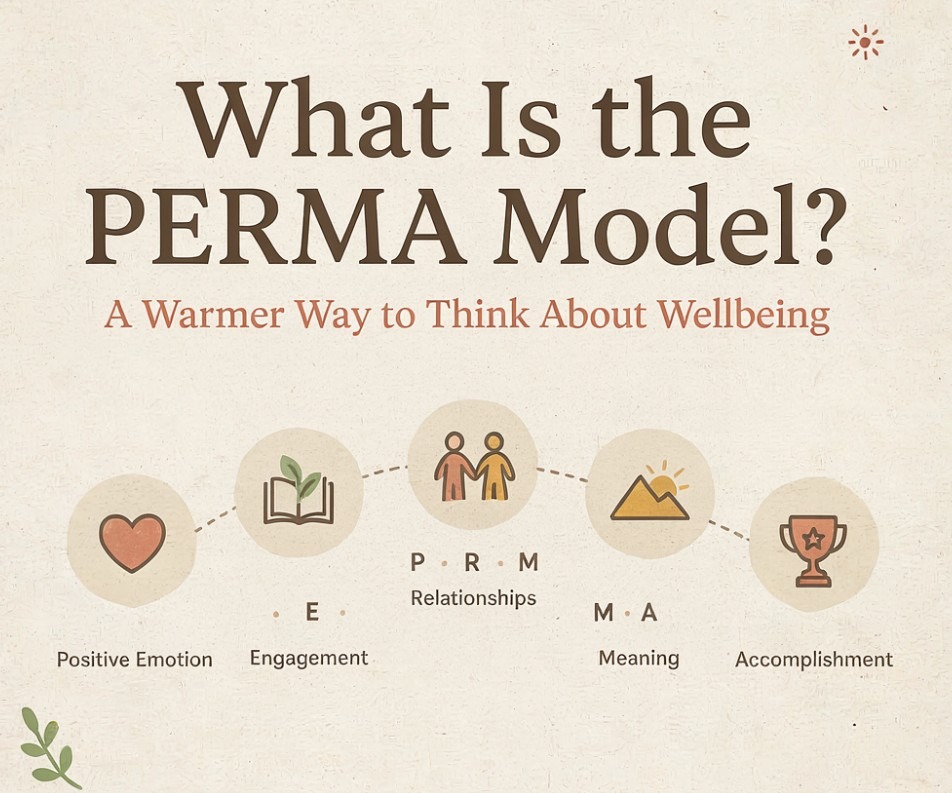
PERMA stands for Positive Emotion, Engagement, Relationships, Meaning, and Accomplishment. Think of them less like a checklist and more like five different rooms in the house of a good life. You don’t have to be sitting in all of them at once, but if a few stay locked for too long, the whole house starts to feel emptier than it should.
The Five Rooms
Positive Emotion is the simplest to spot: joy, gratitude, hope, contentment. It’s the warmth of a good memory or the small lift of noticing something lovely on an ordinary day. It doesn’t have to be big. A good cup of coffee counts.
Engagement is what happens when you lose track of time. Psychologists call it “flow,” that state where a task absorbs you so completely that your phone could buzz three times and you wouldn’t notice. It shows up differently for everyone: for one person it’s untangling a hard problem at work, for another it’s three hours in the garden that felt like twenty minutes.
Relationships are the people who make life feel less like something you’re getting through alone. Trust, warmth, someone who picks up the phone: these are often the pillars that carry the most weight when everything else feels shaky.
Meaning is about belonging to something bigger than your own to-do list. It might come from faith, family, a cause you care about, or simply the sense that your work matters to someone beyond yourself. Meaning is what lets you tolerate a hard week without losing your footing.
Accomplishment is the quiet satisfaction of having done something, not necessarily for applause, just for the sake of doing it well and finishing what you started. Getting a little better at something you care about.
Seligman was careful to say these five aren’t stacked on top of each other in some hierarchy. They each stand on their own, and people flourish through different combinations of them (Seligman, 2018). A validated 23-item tool, the PERMA Profiler, was later developed so researchers could measure all five domains together in a consistent way (Butler & Kern, 2016). Someone might feel deeply fulfilled through relationships and meaning even if their job doesn’t light them up. Someone else might find their engagement and accomplishment carry most of the weight. There’s no single “correct” mix.
Why It’s Worth Paying Attention To
This isn’t just a tidy framework for its own sake; it tends to show up in real outcomes. People who tend to these five areas generally report better physical health, stronger immune resilience, and even longer lives. They tend to do better at work and school, not because they’re grinding harder, but because engagement and purpose naturally pull motivation and creativity along with them. Their relationships tend to run deeper, because feeling good in yourself makes it easier to actually show up for other people. And when hard times hit, because they always do, a life with some meaning and connection already built into it tends to bend without breaking.
Studies applying the PERMA framework to students have found meaningful links between each domain and outcomes like physical health, vitality, and life satisfaction (Kern et al., 2015). At a broader level, researchers studying wellbeing as a matter of public policy have argued that PERMA-style measures capture something that pure income or GDP figures miss entirely (Forgeard et al., 2011). Workplaces that take relationships and purpose seriously, not as a slogan on a wall but as something actually built into how people work, tend to see less burnout and more genuine satisfaction.
It’s also worth noting, in the spirit of honesty rather than salesmanship, that not every researcher is convinced the five pillars are as distinct from one another as they first appear. A widely cited reanalysis found extremely high statistical overlap between the overall PERMA score and simpler measures of general subjective wellbeing, raising the question of whether PERMA is truly five separate ingredients or one underlying sense of wellbeing wearing five different hats (Goodman et al., 2018). That debate doesn’t make the framework useless. It just means it’s best treated as a practical guide for reflection rather than a strict scientific law.
Sarah’s Story
Picture Sarah, a teacher who loved her students but felt like she was running on fumes by October. Nothing was catastrophically wrong; she just felt flat, disconnected, going through the motions. She decided to try working through PERMA, one small piece at a time.
She started with positive emotion: three lines a night about anything, however small, that she was grateful for. A sunny lunch break. A kid who said thank you unprompted. Within a couple of weeks, she noticed she was smiling more without trying to.
Then she turned to engagement. She carved out real time on weekends for gardening, no phone, no half attention, just her hands in the dirt long enough to lose track of the hour. It gave her something work alone couldn’t: a feeling of being fully present.
For relationships, she picked up the phone. A standing video call with an old friend. A local book club she’d been meaning to join for two years. Nothing dramatic, just people, regularly, in her life again.
She found meaning by volunteering with a community literacy program on weekends, which reconnected her to the exact reason she’d become a teacher in the first place.
And for accomplishment, she set goals small enough to actually finish: a short online course, a new skill for her classroom- and let herself feel proud of the small wins instead of waiting for a big one.
None of it was dramatic. But a few weeks in, Sarah noticed the shift: more energy, more hope, lesson planning that used to feel like a chore now felt like it meant something. That’s the real promise of the PERMA model, not a total life overhaul, just steady attention paid to the parts of life that quietly make it worth living.
Bringing PERMA Into Your Own Life
You don’t need to fix everything at once. Pick the pillar that feels most neglected right now and start there.
- Positive Emotion: Keep a short gratitude list. Actually pause to enjoy a good meal instead of eating it while scrolling. Notice when your inner voice is being unfair to you, and push back gently.
- Engagement: Protect time for whatever makes you lose track of the clock, whether that’s music, sport, writing, or something else entirely.
- Relationships: Call someone instead of texting them. Listen fully when a friend talks, instead of half planning your reply.
- Meaning: Ask yourself honestly what you’d want people to say you stood for. Let that answer point you toward a cause, a community, or a habit worth building.
- Accomplishment: Set goals small enough to actually reach, and let yourself feel genuinely proud when you do.
There’s no single right balance between the five. Some people will lean heavily on relationships and meaning; others will find most of their fulfillment through engagement and accomplishment. The point of the PERMA model isn’t to master all five perfectly. It’s to notice which ones have gone quiet in your life, and give them a little more room to breathe.
The Takeaway
So, what is the PERMA model, in the end? It’s less a theory and more an honest map: five ordinary, human things that, tended to over time, add up to a life that feels genuinely worth living. Sarah didn’t need to change everything about her life. She just needed to notice what was missing and give it some attention. That’s really all any of us need to start.
References
- Butler, J., & Kern, M. L. (2016). The PERMA Profiler: A brief multidimensional measure of flourishing. International Journal of Wellbeing, 6(3), 1–48. https://doi.org/10.5502/ijw.v6i3.526
- Forgeard, M. J. C., Jayawickreme, E., Kern, M. L., & Seligman, M. E. P. (2011). Doing the right thing: Measuring wellbeing for public policy. International Journal of Wellbeing, 1(1), 79–106. https://doi.org/10.5502/ijw.v1i1.15
- Goodman, F. R., Disabato, D. J., Kashdan, T. B., & Kaufman, S. B. (2018). Measuring well-being: A comparison of subjective well-being and PERMA. The Journal of Positive Psychology, 13(4), 321–332. https://doi.org/10.1080/17439760.2017.1388434
- Kern, M. L., Waters, L. E., Adler, A., & White, M. A. (2015). A multidimensional approach to measuring well-being in students: Application of the PERMA framework. The Journal of Positive Psychology, 10(3), 262–271. https://doi.org/10.1080/17439760.2014.936962
- Seligman, M. E. P. (2011). Flourish: A visionary new understanding of happiness and well-being. Free Press.
- Seligman, M. E. P. (2018). PERMA and the building blocks of well-being. The Journal of Positive Psychology, 13(4), 333–335. https://doi.org/10.1080/17439760.2018.1437466