
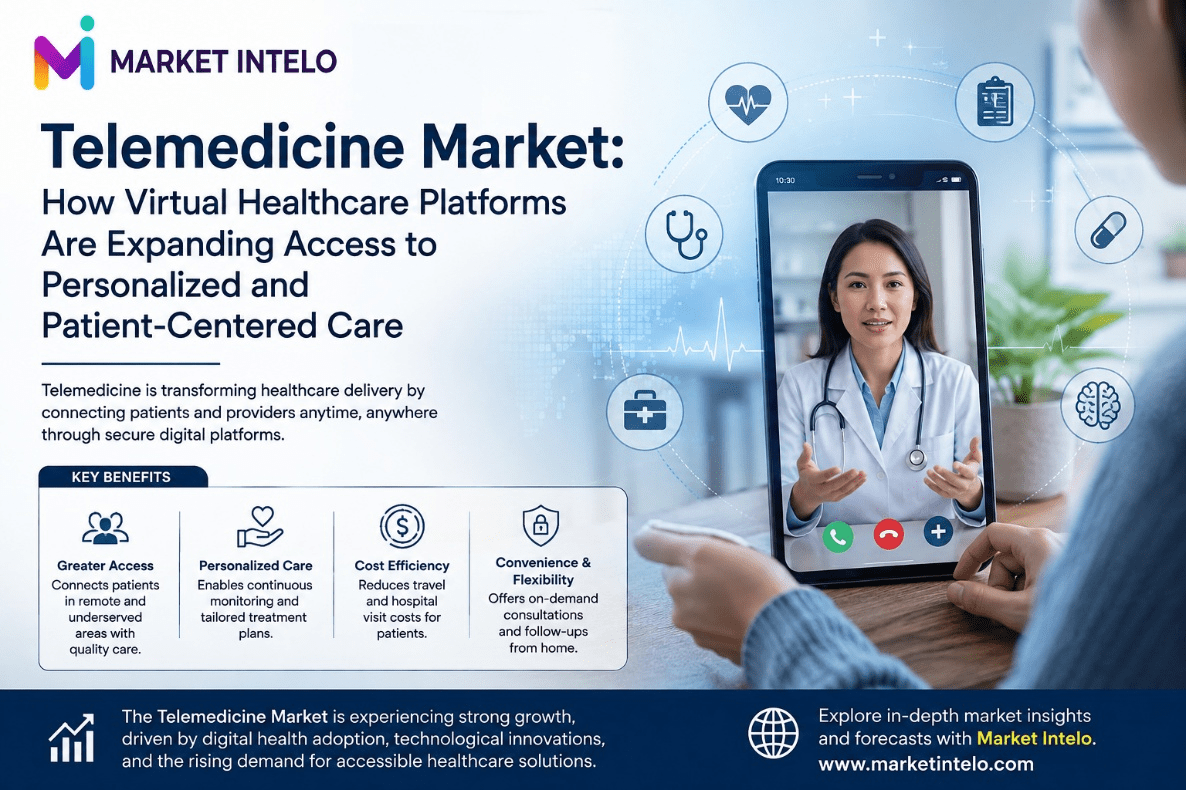

Telemedicine has transitioned from simply being a useful option to becoming a major element of present-day healthcare. Initially starting with virtual meetings and remote consultations, telemedicine is now transforming into an integrated system of virtual medical services that is designed to make the management of chronic conditions, mental health care, follow-ups, and preventive measures easier.
The introduction of telemedicine has changed the way healthcare is perceived by patients, providers, and health institutions, as it is no longer just about expanding access to medical services; it has become a tool for delivering quality healthcare that is more focused on patients’ needs and tailored to their specific requirements.
The Scale of the Shift: Telemedicine Market Growth
The extent of this change can also be seen in the most recent market data: According to MarketIntelo, the global telemedicine market valued at about $142.5 billion in 2025 is expected to grow to around $547.8 billion by 2034, making an annual growth of about 17.2% (CAGR).
The following factors drive this market:
- an increasing demand for remote and hybrid care solutions
- an increasing scope of reimbursement for telemedicine sessions and telemonitoring
- progress in AI, Internet of Things, and reliable communications systems
- an increase in the patients’ expectations related to convenient digital healthcare.
This growth does not mean just more video calls; it means the creation of an e-environment for health including all aspects of health, which is now understood as whole-person health.
From “Virtual Visits” to Integrated Care Platforms
The initial telemedicine technology was limited to video conferencing with patients. However, the current technology has more options, including:
- Synchronous care: This includes services like live video, phone calls, and chats.
- Asynchronous care: This includes secure messaging, eVisits, and other forms.
- Remote Patient Monitoring: This is done via electronic devices and personal wearables.
- Care coordination: This involves connecting a patient’s primary care physician, specialists, pharmacy, and home care.
- Patient engagement: This area covers modules for patients and their reminders.
This makes telehealth a multi-faceted tool that works together with the medical establishments a patient uses.
Why Virtual Platforms Matter for Personalized, Patient-Centered Care
What is personalized care? This means that treatment can be adjusted to suit the person’s individual clinical background and lifestyle, along with their individual likes and dislikes. Patient-centered care means that services are provided based on what matters most to the patient in terms of convenience, clear communication, constant care, and confidence in the process.
Virtual healthcare platforms can provide help in achieving both types of care mentioned above.
- Increased accessibility and convenience
People living in remote areas, patients with mobility issues who cannot travel easily, and those with busy schedules can get access to care without having to deal with traveling or waiting in line at a doctor’s office, and this will come in handy in the following cases:
- Conditions that require follow-up appointments regularly
- Mental health issues and psychological care
- Monitoring and rehabilitation after hospital discharge
- Visiting a specialist, which would otherwise involve waiting
The virtual platforms have played a major role in better connecting patients with their care programs by eliminating logistical obstacles, a vital part in developing self-efficacy.
- More Continuous, Data-Driven Care
Mobile devices and applications enable patients to report their health status and adherence information on adherence spontaneously. This allows healthcare professionals to:
- Identify changes in patients’ health status and intervene in advance
- Change medications and treatment regimens guided by information patients provide from home
- Minimize unnecessary visits while maximizing contact with patients
This uninterrupted data delivery system supports personalized decision-making and timely feedback, which promotes motivation.
- Support for Whole-Person and Behavioral Health
Digital platforms provide opportunities to combine physical healthcare and mental healthcare services. Patients can benefit from various services, such as:
- teletherapy and counseling,
- digital CBT and other mental health services,
- social support and care navigation services.
This comprehensive approach is consistent with the idea of patient-centered care, whereby the focus is not merely on diseases but on the overall care of patients. The use of technology also allows incorporating positive psychology methods, such as strengths-based coaching, gratitude exercises, and goal-setting methodology in digital care offerings.
- Hybrid Care Models
Several companies shift to a hybrid model, where in-person and virtual care are integrated. Examples of hybrid care are:
- Face-to-face examination of patients followed up by video appointments;
- Procedures done in a clinic, whereas patients receive pre- and post-op services remotely;
- Programs for chronic condition patients that include visits to the office, while monitoring patients through different devices remotely.
Patients appreciate the opportunities hybrid models suggest; they now feel they have more options, and this translates into reduced stress levels and greater independence.
Market Dynamics: What’s Driving Telemedicine Growth?
A few different structural factors are boosting the telemedicine market’s growth.
Rising Healthcare Costs and Provider Shortages
It is predicted that in 2030, health care spending will amount to $12.8 trillion, which will result in the need for cost-saving solutions. Telemedicine saves between 30 and 45% of expenses per patient, while improving access to healthcare for people in areas where there is a severe lack of doctors.
In the USA only, the shortage of doctors will be between 37,800 and 124,000 by the year 2034. One of the solutions offered by telemedicine is to shift simple tasks from physicians to nurses, physician assistants, and health technicians, which increases the work efficiency of doctors due to the equal distribution of their duties:
- Unneeded trips to the emergency department reduced by 18–24%
- Hospital readmission rates decreased by 15–20%
- Reduced average stay in hospitals by 2–3 days
Healthcare systems that utilize diverse telemedicine methods have recorded a 15-25% increase in their operational efficiency and a 12-18% rise in the number of patients served.
Digital Health Infrastructure and Connectivity Expansion
The global penetration of smartphones is expected to reach 68% by 2025, with approximately 6.8 billion mobile users making way for unprecedented communication without internet interference. High-speed internet access emerges exponentially, with 4G/5G cellular coverage reaching the mark of 78% of the world’s population by 2026, which allows for the use of video consultations and the streaming of online information.
The cost of cloud computing infrastructure has gone down by 65 percent since 2015, meaning that telemedicine software is now available to small and medium-sized health organizations. The use of wearable technology is thought to be rising rapidly, with more than 1.1 billion devices being sold worldwide in 2025, thus generating constant streams of data for remote monitoring analytics.
Chronic Disease Burden and Aging Demographics
Chronic Disease Load and Ageing Demographics
In the world, over 700 million persons suffer from non-communicable diseases (NCDs), like diabetes, hypertension, heart issues, and breathing problems, causing 71% of deaths globally. There are an estimated to be around 422 million persons suffering from diabetes, which has increased by 92% since 2000 and is growing especially in underdeveloped countries.
The aging population in developing countries has led to an unprecedented increase in the need for treatment for chronic diseases and elderly care, where the number of people aged 65 and older will reach a 16% share of the total world population by 2026. With the help of telemedicine, receiving healthcare remotely has led to a 21% – 35% reduction in hospitalizations among patients with chronic diseases and a 17% – 23% increase in adherence to treatment. The patients suffering from various chronic diseases who have used telehealth technologies rated their satisfaction with the services as 38% higher than those receiving conventional services, mainly because they were able to save time and energy getting services remotely.
Regulatory Support and Reimbursement Expansion
The evolution of regulatory frameworks has been significant, as 127 nations have approved telehealth services that offer equal remuneration for virtual consultations. In the USA, CMS introduced 100+ billing codes for telehealth services in 2025, including other forms of telehealth like remote therapeutic monitoring and behavioral health care management.
In Japan, 220 new telehealth-covered medical conditions were introduced in 2025. The growth seen in telehealth services in Japan reached 41 percent in virtual consultations as compared to the previous year. In China, over 2400 telehealth service codes were approved by the National Healthcare Security Administration with equal payment as compared to in-person appointments. Medicare Benefits Schedule of Australia has facilitated the process of telehealth service delivery by offering telehealth services for almost 98% of general practice consultations and other services.
Telemedicine and the PERMA Model: A Natural Fit
The PERMA framework—which stands for Positive Emotion, Engagement, Relationships, Meaning, and Accomplishment—provides a helpful framework for thinking about how virtual care can contribute to well-being in addition to treating disease.
- Positive Emotion: Provides timely and encouraging feedback from healthcare professionals, easy-to-use interfaces that mitigate frustration, and functions that model small accomplishments (such as consistent medication intake and progress in measurements)
- Engagement: Contains tools for self-monitoring, education, and goal-setting that engage patients in their own treatment.
- Relationships: Features regular virtual check-ins, private messaging, and the ability to allow family members to join the appointment
- Meaning: Has care plans that give patients a better understanding of how their actions are connected to future goals (such as enabling them to be active with their family, going back to work, or traveling).
- Accomplishment: Has effective monitoring that allows patients to track progress, be notified regarding milestones, and be acknowledged professionally for their improvements.
Telemedicine platforms do not have to be called “positive psychology tools” to produce such results. These platforms often simply provide an experience that was designed with empathy and encouragement in mind.
Regional Outlook
The telemedicine market is undergoing global expansion, with the pattern of adoption varying around the world. The Asia Pacific region has emerged as the leading regional market with 38.5% of worldwide telemedicine revenues projected in 2025, with a total market value of $54.8 billion. The region is experiencing rapid growth owing to the existence of a population of 4.6 billion people, rapid advancements in digital technology in countries such as India, China, and Vietnam, and government policies promoting the digitalization of health care systems. The contributing figures include projections that by 2030 India will register about 250 million new internet users, greatly increasing the potential market of telemedicine services.
North America holds 28.2% of the worldwide telemedicine market due to high digitalization levels in the United States and Canada. The key feature of the region is the consolidation of health systems, whereby over 85% of US hospitals can provide telehealth services, while in 2019 only 38% of them offered such services. The situation with telemedicine in US primary health care is characterized by high levels of penetration at more than 42%.
Europe holds a significant proportion of the telemedicine market, accounting for 18.4%. The region boasts a robust digital health ecosystem and favorable regulations in the EU. Countries such as Germany, the UK, France, and Spain have started adopting telemedicine rapidly, with 25-30% of consultations taking place digitally. Nordic countries dominate the telemedicine market in Europe, as more than 45% of primary healthcare consultations are done via telemedicine services.
When combined, Latin America as well as the Middle East and Africa account for 14.9% of the market, with fast growth being facilitated by mobile health technologies as well as collaboration strategies with established international telemedicine suppliers.
Segment Insights: Where the Market Is Heading
By Component
- Software occupies a major role in the telemedicine industry, taking up 54.7% of revenue by 2025, estimated at $77.9 billion. Telemedicine software systems have developed from basic video calling programs to integrated systems with electronic health records, diagnostic help system, AI-assisted diagnosis, and patient engagement systems.
- Hardware makes up 22.4% of the market value, driven by the prevalence of connected medical devices and infrastructure in telemedicine setups.
- The services segment accounts for 22.9% of the total market value, including the consulting, implementation, training, and maintenance services required for telemedicine deployment.
By Mode of Delivery
- Cloud-Based delivery systems dominate at 42.3%, owing to the implementation of enterprise cloud technology, expansion possibilities associated with cloud solutions, and minimal upfront investment. Currently, over 280 million patients are utilizing cloud platforms across the globe, conducting 1.2 billion virtual visits every year while enjoying 99.99% uptime.
- Web-Based delivery makes up 35.2% of the market with simple solutions that can be used from various devices under various connectivity conditions.
- On-Premises delivery manages to retain 22.5% market share due to usage among the big healthcare systems that already have their IT infrastructure and strict regulations on data location.
By Application
- Telecardiology is regarded as the leading application segment in terms of market share, accounting for 19.8% of the overall revenue earned from telemedicine. Cardiovascular diseases are known to be the largest cause of mortality worldwide, with around 523 million people suffering from this affliction.
- Teleradiology has an 18.4% market share, owing to the acute shortage of radiologists and the high market value offered by diagnostic imaging of the highest quality.
- Telepsychiatry has the third-largest share in telemedicine revenue at 17.6%, helping in addressing the mental illness crisis affecting 792 million people globally.
- Telepathology constitutes 14.2% of the market, allowing pathologists to examine digital pathology slides and diagnose from anywhere.
- Teledermatology accounts for 12.8% of the application revenue, making it suitable for monitoring skin diseases.
- Other applications include telewellness, teleoccupational health, and specialty services, making up 17.2% of the market share.
By End-User
- The hospitals’ segment has the biggest share in the telemedicine market, accounting for 38.6%.
- Clinics and outpatient centers make up 31.2% of this market, highlighting how telemedicine for primary care and specialty clinics is utilized
- The home care segment contributes 18.9% to the sector’s revenues due to remote patient monitoring and virtual visits from nurses.
- Other end-users include corporate occupational health providers, retail clinics, and telemedicine platforms that comprise 11.3% of the total revenue.
Challenges and Considerations
Despite strong momentum, several challenges remain:
- The uncertainties surrounding regulations: The differing telemedicine laws among 127 countries have posed serious compliance issues for global providers.
- Cybersecurity risks: Organizations in the healthcare sector have reported a 35 percent rise in ransomware attacks against telemedicine systems.
- The problem of inequality: Some patients lack the necessary internet connection, devices, or digital skills.
- Integration into the workflow: Online tools should be integrated into the workflow seamlessly, and not add to the workload of professionals.
- Equal opportunity and access: Making sure that remote medicine does not increase the differences between vulnerable groups.
- Opposition from physicians: Among various specialties, 28 percent of orthopedic surgeons and 23 percent of ophthalmologists feel doubtful about the accuracy of diagnosis and possible legal complications.
To deal with these problems, cooperation between providers, payers, regulators, and technology vendors is needed. Furthermore, it requires a human-centered design mindset in which the emotional and psychological aspect of utilizing those platforms is taken into account in addition to clinical and operational measures.
Opportunities on the Horizon
The global telemedicine industry has vast opportunities for growth in different spheres:
- A sunk cost of less than 15% in telemedicine utilization gives potential for 600+ million patients in the future,
- Several established virtual healthcare branches like telehabilitation, teleophthalmology, and telenursing have an annual growth of 25%–30% and adequate profit planning formats.
- The market for telemedicine for mental health issues is especially promising, as till now only 32% of patients in this category use the services of a telepsychiatrist, despite difficulties in the provision of services and 300+ million individuals dealing with mental health problems worldwide.
- Using telemedicine in recovery after surgery, stroke rehabilitation, and orthopedic injury healing has shown an annual growth of 28% due to the development of tickets on vibrational sensors.
- Usage of telemedicine for elderly people with medical examination, medication checking, and cognitive functioning testing has grown rapidly, reaching 125 million users in developed.
The Road Ahead: Toward Truly Patient-Centered Virtual Care
Thus, in the next 10 years, we will likely see virtual healthcare systems:
- Improved integration with EHRs and clinical pathways, enabling better use of virtual data in clinical decision-making.
- More personalization through AI so that the relevant content, reminders, and interventions will reach individual risk profiles and preferences.
- Increase in home-based care, with more monitoring, diagnostics, and some treatments happening at home.
- Greater attention to equity, with the systems being designed specifically to serve marginalized communities.
As a result, telemedicine in the future will not be so much about virtual care vs. in-person care, but rather about providing the best-suited method of treatment for every patient.
Conclusion
The telemedicine sector is currently reaching higher levels, as virtual care outlets transition from being complementary elements to an essential part of patient-oriented treatments. According to an assessment of global market development, it is expected to grow from $142.5 billion in 2025 to $547.8 billion in 2034, with an annual growth rate of 17.2%. Virtual treatment has grown into an essential aspect of health services available to different patients.
Providers who can ensure that patients can use equitable virtual care models while ensuring adequate protection of privacy, simplicity of processes, fair remuneration of employees, and safety will likely contribute to the positive outcomes achieved and the improvement in patient experience.
Let ecommerce industry trends guide you and provide essential information regarding modern virtual care in various channels.
Reference: https://marketintelo.com/report/telemedicine-market