


Inner awareness, positive psychology and the PERMA model for digital health founders
Abstract
Digital health founders work under high pressure while trying to improve the health of others. Research shows that entrepreneurs face a higher risk of stress and mental health difficulties than many other workers. This article explains spirituality as the exploration of consciousness, meaning and purpose. It separates spirituality from organised belief systems and links it to positive psychology and the PERMA model. It ends with practical use cases that founders can apply immediately.
Introduction
Digital health is a field built on care. Founders create apps, platforms and tools that help people manage illness, sleep, stress and recovery. Yet the people building these tools often neglect their own health. Long hours, uncertain funding and constant change make this almost the default.
The evidence supports this concern. Freeman and colleagues (2019) found that entrepreneurs report higher rates of conditions such as depression, attention difficulties and anxiety than comparison groups. Wiklund et al. (2019) reviewed the field and concluded that entrepreneurship can bring both great satisfaction and serious strain. Attention to digital health entrepreneur wellbeing is therefore a practical need and not a luxury.
This article offers one useful path: building a mature relationship with the inner self through spirituality. It also shows how positive psychology gives this idea a scientific structure.
What Spirituality Means
Spirituality is the personal effort to understand consciousness. Consciousness is your awareness of your own thoughts, feelings and experiences. A spiritual person asks simple but deep questions. Who am I beyond my job title? What matters most to me? How do I want to live and work?
In this sense, spirituality is an inner practice. It involves observing the mind, noticing reactions and connecting with a sense of purpose. It does not require a group, a building or a set of rules. A founder can practise it alone during a quiet walk, a few minutes of silent breathing or a daily journal entry.
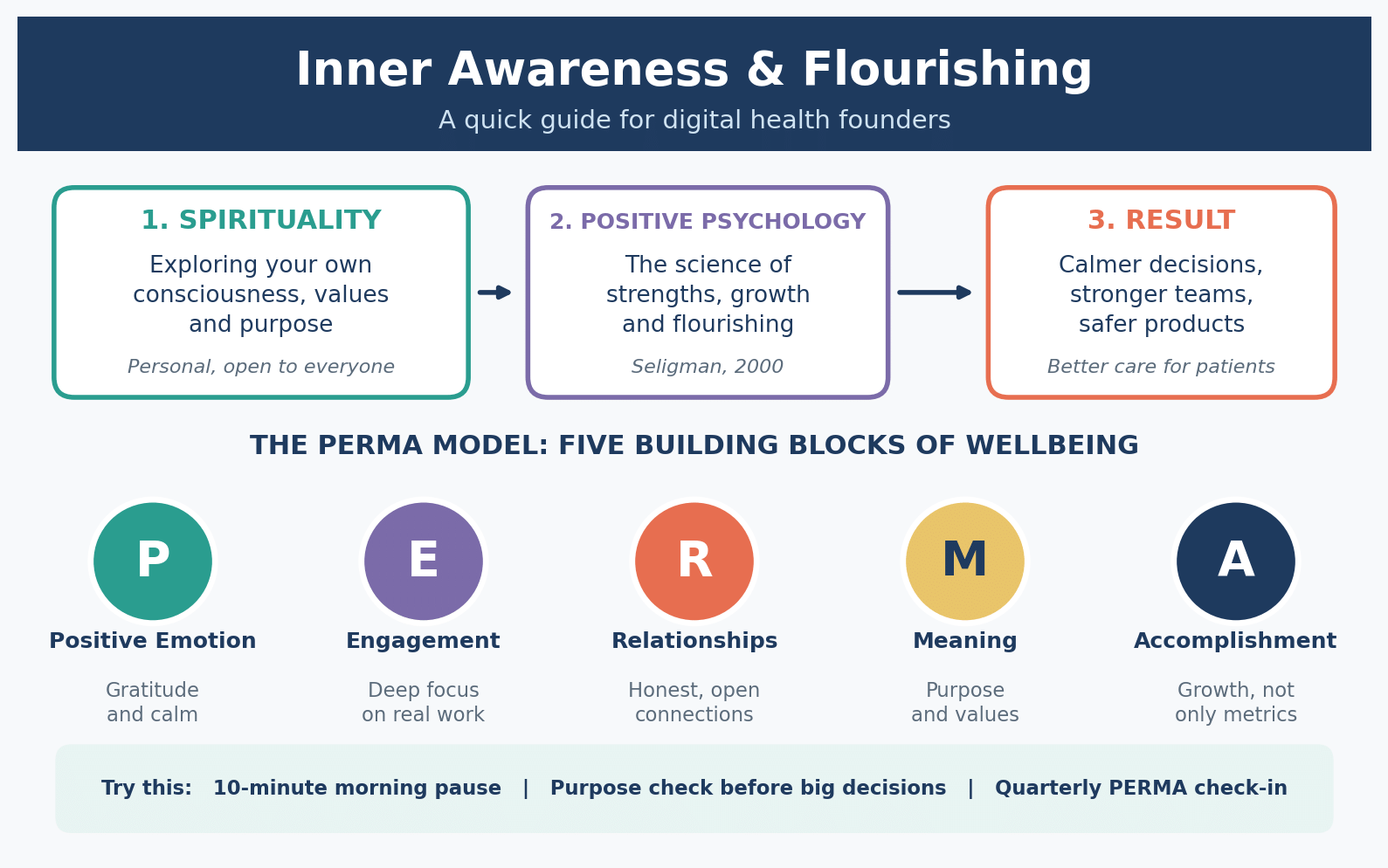
Figure 1. From inner awareness to flourishing: a summary for digital health founders.
Spirituality Versus Religion
People often use these two words as if they mean the same thing, but they differ in important ways. Religion usually refers to an organised system. It includes shared beliefs, community traditions, rituals and moral codes that groups follow together. Spirituality is more personal and more open. It focuses on direct experience and on a person’s own search for meaning.
Someone can value spirituality without belonging to any organised system. Another person may follow a structured system and also have a deep inner life. This article concerns only the first idea: an individual’s exploration of awareness, values and purpose. That focus keeps the topic open to every founder, whatever their background or beliefs.
Why Spirituality Matters for Founders
Founders carry a heavy mental load. They make fast decisions, manage uncertainty and often tie their identity to the success of their company. When the company struggles, they may feel that they are failing as people. Spirituality helps by creating some distance between the self and the business.
Several research findings support this. Brown and Ryan (2003) showed that mindful awareness, which means paying attention to the present moment without judgment, is linked to better emotional regulation and higher psychological wellbeing. Steger and colleagues (2006) found that a strong sense of meaning in life is associated with greater life satisfaction. Both ideas sit at the heart of spiritual practice.
In digital health, meaning has special weight. Founders chose this field because they want to help people. When they lose touch with that purpose, work becomes exhausting. When they reconnect with it, the same work can feel energising.
Positive Psychology: A Science of Flourishing
For many years, psychology focused mainly on illness and dysfunction. Seligman and Csikszentmihalyi (2000) called for a shift toward the study of strengths, positive emotions and human flourishing. This movement became known as positive psychology. Its goal is not only to reduce suffering but also to help people build a life worth living.
This approach suits entrepreneurs well. Instead of asking only how to avoid burnout, it asks how to create the conditions for lasting energy, creativity and satisfaction.
The PERMA Model
Seligman later proposed the PERMA model, which describes five building blocks of wellbeing. Butler and Kern (2016) developed the PERMA-Profiler to measure these elements in a reliable way. Here is how each one connects to spiritual awareness.
Positive emotion. This means feeling joy, gratitude, hope and calm. Spiritual practices such as reflection and gratitude journaling help founders notice good moments, even in a hard week.
Engagement. This is the feeling of being fully absorbed in meaningful work. Awareness practices train attention, which makes deep focus easier.
Relationships. Strong and honest connections protect wellbeing. A founder who understands their own mind tends to listen better and react less defensively to co-founders, staff and investors.
Meaning. This means serving something larger than yourself. Spirituality directly supports this element by encouraging regular reflection on purpose and values.
Accomplishment. This is the sense of progress and mastery. When success is tied to values and not only to metrics, achievements feel more satisfying and less empty.
Together, these five elements show that wellbeing is built from several parts. Spirituality strengthens each of them, and meaning in particular.
Practical Use Cases
The ideas above become useful only when applied. The following examples show how.
Use case 1: The morning pause. A founder of a mental health app begins each day with ten minutes of quiet reflection. She notes her mood, sets one intention and thinks about the users she wants to help. Over several weeks, she feels calmer during meetings and makes fewer rushed decisions. This practice supports positive emotion and engagement.
Use case 2: Purpose-led decisions. A team building a remote monitoring platform faces a choice between a profitable feature and one that better serves patients. The CEO asks everyone to pause and reflect on the company’s core purpose before voting. The discussion becomes clearer and more honest. This supports meaning and healthy relationships within the team.
Use case 3: Recovery after a setback. A founder loses a major funding round and feels his identity is under threat. He uses a journal to separate his self-worth from the outcome. He writes about what he learned and what he values most. Within a few weeks, he feels ready to try again. This supports accomplishment by redefining success as growth and not only results.
Use case 4: A wellbeing check for the team. A start-up leader uses the PERMA-Profiler once every quarter with her staff. The results show that meaning scores are low in the engineering team. She holds a session where developers meet real users and hear how the product helps them. Meaning scores rise in the next survey. This shows how a measurable tool and a purpose-based activity can work together.
Why This Matters for the Digital Health Sector
A founder under constant strain can make poor choices, overlook risks and lose touch with users. A founder with a clear and calm mind is better able to protect patient trust, lead a healthy team and build ethical products. In this way, personal wellbeing and product quality are closely connected. Supporting digital health entrepreneur wellbeing therefore benefits not only founders but also the patients and clinicians who rely on their tools.
Limitations
Spirituality is not a replacement for professional care. Founders who experience persistent low mood, severe anxiety or signs of burnout should speak with a qualified health professional. Spiritual practice works best as a supportive habit alongside good sleep, healthy boundaries, social support and, when needed, therapy. Researchers also note that more studies are needed that focus directly on entrepreneurs in health technology.
Conclusion
Digital health founders spend their days caring for the health of others, but their own wellbeing deserves equal attention. Spirituality, understood as the exploration of consciousness, purpose and meaning, offers a simple and personal way to build inner strength. Positive psychology and the PERMA model give this idea a clear scientific frame and practical tools for measurement. By pausing to reflect, aligning decisions with purpose and checking in on wellbeing regularly, founders can build companies and lives that are both successful and sustainable. Strengthening digital health entrepreneur wellbeing is an investment in better care for everyone.
References
1. Brown, K. W., & Ryan, R. M. (2003). The benefits of being present: Mindfulness and its role in psychological well-being. Journal of Personality and Social Psychology, 84(4), 822–848. https://doi.org/10.1037/0022-3514.84.4.822
2. Butler, J., & Kern, M. L. (2016). The PERMA-Profiler: A brief multidimensional measure of flourishing. International Journal of Wellbeing, 6(3), 1–48. https://doi.org/10.5502/ijw.v6i3.526
3. Freeman, M. A., Staudenmaier, P. J., Zisser, M. R., & Andresen, L. A. (2019). The prevalence and co-occurrence of psychiatric conditions among entrepreneurs and their families. Small Business Economics, 53(2), 323–342. https://doi.org/10.1007/s11187-018-0059-8
4. Seligman, M. E. P., & Csikszentmihalyi, M. (2000). Positive psychology: An introduction. American Psychologist, 55(1), 5–14. https://doi.org/10.1037/0003-066X.55.1.5
5. Steger, M. F., Frazier, P., Oishi, S., & Kaler, M. (2006). The Meaning in Life Questionnaire: Assessing the presence of and search for meaning in life. Journal of Counseling Psychology, 53(1), 80–93. https://doi.org/10.1037/0022-0167.53.1.80
6. Wiklund, J., Nikolaev, B., Shir, N., Foo, M.-D., & Bradley, S. (2019). Entrepreneurship and well-being: Past, present, and future. Journal of Business Venturing, 34(4), 579–588. https://doi.org/10.1016/j.jbusvent.2019.01.002