


Background
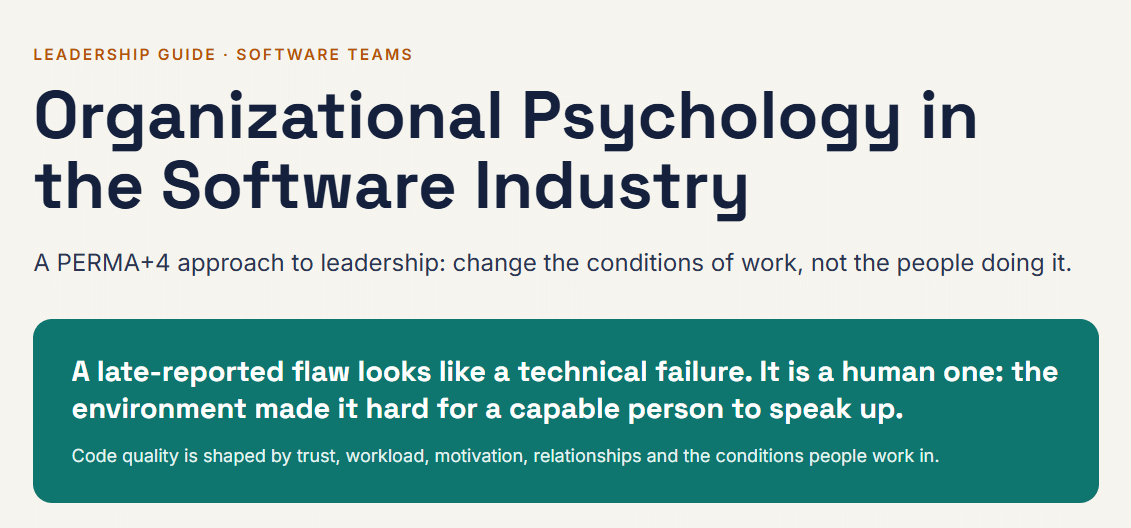
A software engineer notices a serious flaw shortly before a release. The deadline is close, the sprint board is full, and the last person who raised a concern was told to “be more solution-focused”. The engineer hesitates. The issue is reported late, the release is delayed and the team spends two days firefighting. It may look like a technical failure. Yet something human has happened: the working environment has made it difficult for a capable person to speak up. This is why Organizational Psychology in Software Industry matters to leadership teams. It examines how people think, feel, communicate and perform within the systems organisations create. Software is built through code, but the quality of that code is also influenced by trust, workload, motivation, relationships and the conditions in which people work.
Why Organisational Psychology Matters in Software
Software professionals must navigate changing requirements, technical debt, security risks and demanding delivery schedules. Developers, testers, product managers and designers rely on both concentration and collaboration. Even technically capable teams struggle when priorities constantly shift, people fear questioning decisions or interruptions prevent focused work. Wellbeing initiatives cannot compensate for a culture that rewards excessive hours and firefighting. Organisational psychology asks leaders to examine the wider work system: leadership behaviour, relationships, role clarity, job design, recognition and resources. It helps make technical excellence sustainable.
Applying PERMA+4 to Software Teams
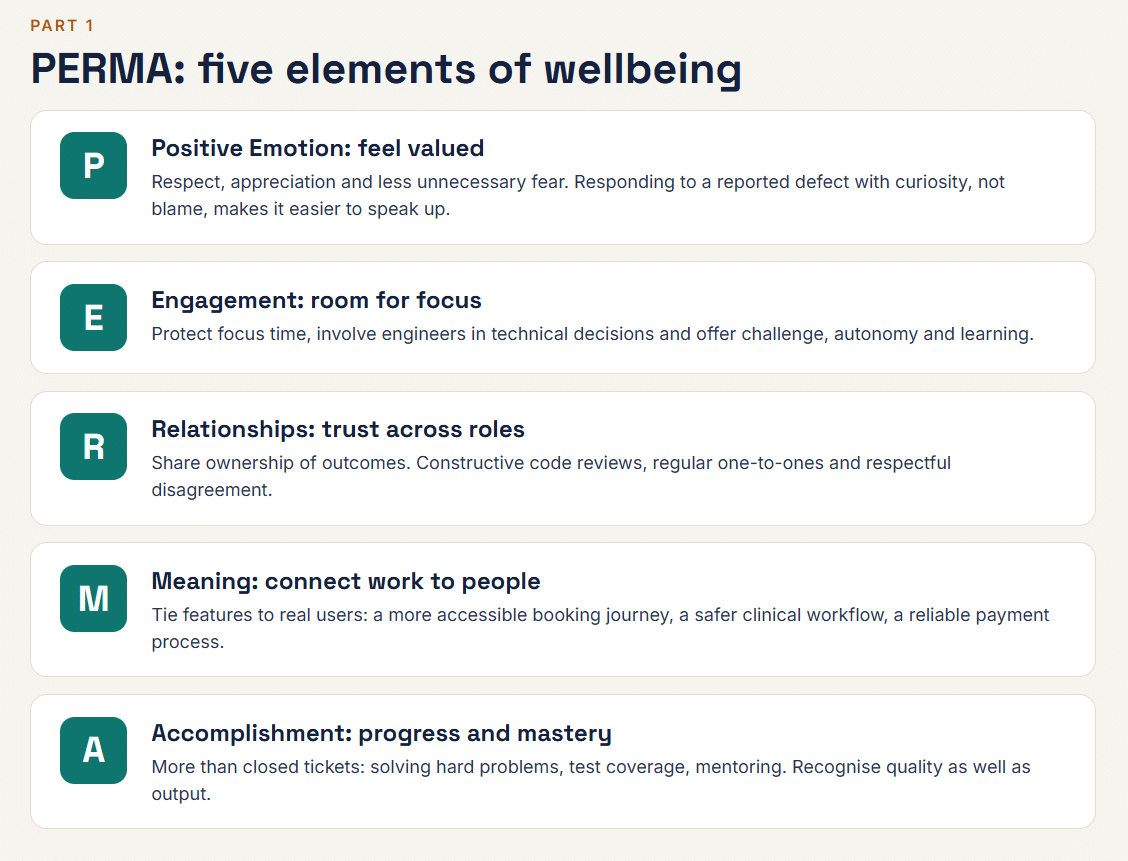
The PERMA+4 framework offers a useful leadership lens. PERMA identifies five elements of wellbeing: Positive Emotion, Engagement, Relationships, Meaning and Accomplishment. The four additional workplace elements are Physical Health, Mindset, Work Environment and Economic Security (Donaldson et al., 2022). These are not employee perks or an HR checklist; they are connected aspects of the environment leaders shape.
Positive Emotion – helping people feel valued. This is not forced positivity. It is respect, appreciation and less unnecessary fear. A manager who responds to a reported defect with curiosity rather than blame makes it easier for others to speak up.
Engagement – making room for meaningful focus. Software development requires concentration. Repeated meetings and shifting priorities fragment attention. Protect focus time, involve engineers in technical decisions and provide appropriate challenge, autonomy and learning opportunities.
Relationships – building trust across roles. Developers, testers and product teams should share ownership of outcomes rather than treating one another as obstacles. Encourage constructive code reviews, regular one-to-ones and respectful disagreement. People need to be able to ask questions, admit uncertainty and raise mistakes without humiliation. A 2025 systematic review of software workplaces identifies leadership, team autonomy and agile practices as factors associated with psychological safety, alongside links to team dynamics, job satisfaction and software quality (Santana et al., 2025).
Meaning – connecting work to people. Developers may work on a feature without knowing why it matters. Connect technical work to real users: a more accessible booking journey, safer clinical workflow or reliable payment process. Knowing whom the work serves can give everyday tasks purpose.
Accomplishment – recognising progress and mastery. Accomplishment is more than closed tickets or sprint targets. It includes solving difficult problems, improving test coverage, mentoring and learning. Set realistic goals and recognise quality as well as output.
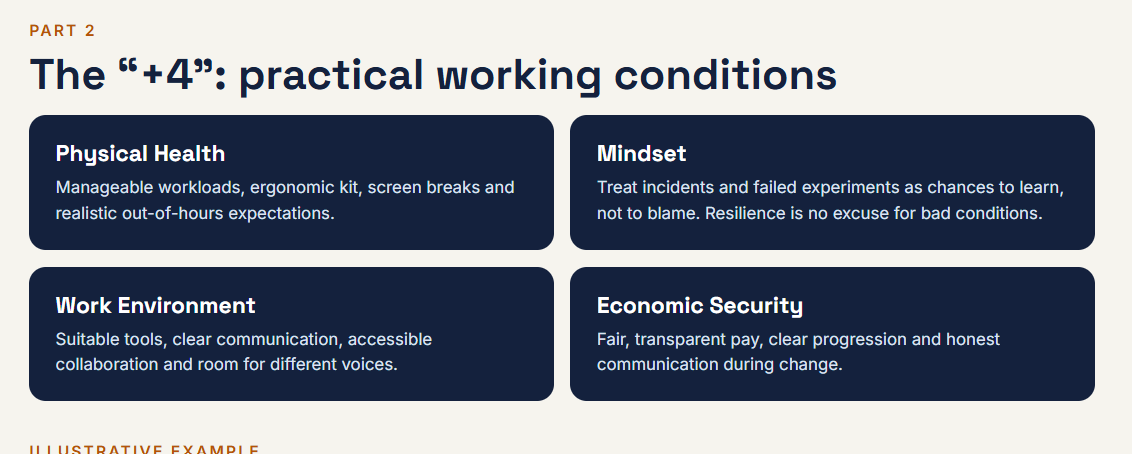
The “+4” elements bring practical working conditions into the picture.
Physical Health includes manageable workloads, ergonomic equipment, screen breaks, healthy working patterns and realistic out-of-hours expectations. Exhaustion undermines thoughtful problem-solving.
Mindset concerns how teams respond to challenges and setbacks. Leaders can encourage learning by treating incidents and failed experiments as opportunities to understand what happened, rather than occasions to assign blame. Resilience must not become an excuse for keeping people in persistently difficult conditions.
Work Environment includes the physical and psychological setting. Every team needs suitable tools, clear communication, accessible collaboration and room for different voices.
Economic Security includes fair and transparent pay, clarity about roles and progression, and honest communication during organisational change. Uncertainty and unfair progression undermine security.
An Illustrative Example: Change the Conditions, not the People
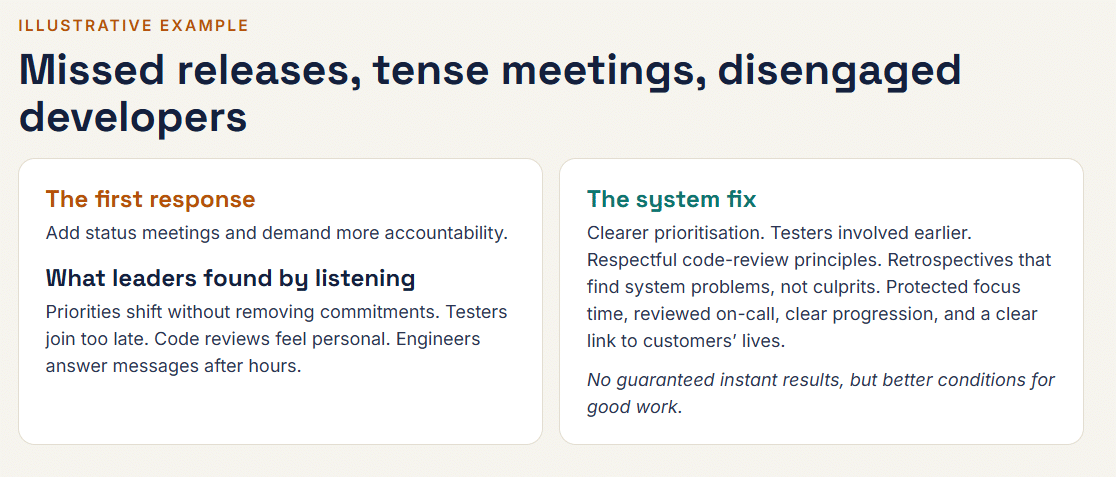
Consider a software company that has missed several release dates. Defects are found late, meetings are tense and experienced developers are disengaging. Leaders respond by adding status meetings and demanding greater accountability. Priorities change without removing existing commitments, testers join too late, code reviews feel personal and engineers answer messages after hours.
Instead, leaders listen.
The company responds by agreeing a clearer prioritisation process, involving testers earlier, setting respectful code-review principles and using retrospectives to identify system problems rather than blame individuals. It protects focus time, reviews on-call arrangements, clarifies progression criteria and explains how the product improves customers’ lives.
These changes do not guarantee immediate results or replace technical discipline. They address conditions that make good work harder, giving the team greater clarity, a stronger voice and more realistic support. This is organisational psychology in practice: linking people, work design and performance.
What Leadership Teams can do Next
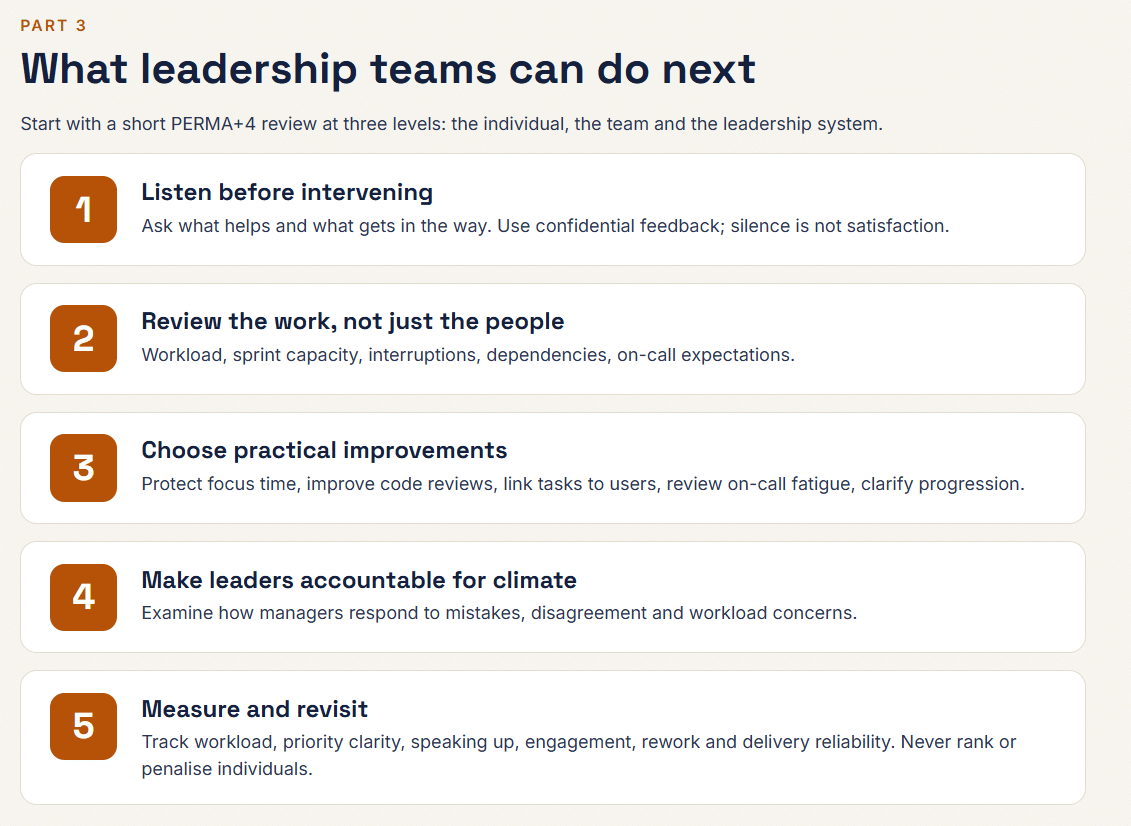
Start with a short PERMA+4 review at three levels: the individual, the team and the leadership system. Systems-informed research supports looking beyond individual wellbeing to the relationships between employees, teams and supervisors (Donaldson et al., 2024).
- Listen before intervening. Ask what helps people do their best work and what repeatedly gets in the way. Use confidential feedback as well as team discussions; silence should not be mistaken for satisfaction.
- Review the work, not just the people. Examine workload, sprint capacity, interruptions, dependencies, decision-making and on-call expectations. Look for recurring causes of missed deadlines and rework.
- Choose practical improvements. Protect focus time (Engagement), improve code-review conversations (Relationships), connect tasks to user outcomes (Meaning), review on-call fatigue (Physical Health) and clarify career progression (Economic Security).
- Make leaders accountable for the climate they create. Examine how managers respond to mistakes, disagreement and workload concerns. Psychological safety is shaped by everyday behaviour, not a poster or one-off workshop. Edmondson’s foundational study linked team psychological safety with learning behaviour in work teams (Edmondson, 1999).
- Measure and revisit. Track a small set of indicators, such as workload, clarity of priorities, ability to speak up, engagement, avoidable rework and delivery reliability. Use feedback alongside operational data; never turn wellbeing scores into a way to rank or penalise individuals.
The Leadership Opportunity
The future of software will depend on more than faster development cycles, new tools or automation. It will also depend on organisations that can attract and retain people who think clearly, collaborate well and respond creatively to complex challenges.
Organizational Psychology in Software Industry gives leadership teams a way to examine the human side of performance with the same seriousness they bring to architecture, security and delivery. PERMA+4 offers a practical lens, provided it is used to improve the conditions of work rather than asking individuals to become more positive about difficult conditions.
A flourishing software organisation is not free from pressure or disagreement. It is one where people can raise concerns, learn from setbacks, feel valued and have the resources to do good work. This is part of building performance that lasts.
References
- Donaldson, S. I., van Zyl, L. E., & Donaldson, S. I. (2022). PERMA+4: A framework for work-related wellbeing, performance and positive organizational psychology 2.0. Frontiers in Psychology, 12, 817244. https://doi.org/10.3389/fpsyg.2021.817244
- Donaldson, S. I., Donaldson, S. I., McQuaid, M., & Kern, M. L. (2024). Systems-informed PERMA+4: Measuring well-being and performance at the employee, team, and supervisor levels. International Journal of Applied Positive Psychology, 9(2), 1153–1166. https://doi.org/10.1007/s41042-024-00177-y
- Edmondson, A. (1999). Psychological safety and learning behavior in work teams. Administrative Science Quarterly, 44(2), 350–383. https://doi.org/10.2307/2666999
- Santana, B., Monte, L., Silva, B. S. de A., Carneiro, G. de F., Freire, S., Santos, J. A. M., & Mendonça, M. (2025). Psychological safety in software workplaces: A systematic literature review. Information and Software Technology, 187, 107838. https://doi.org/10.1016/j.infsof.2025.107838