
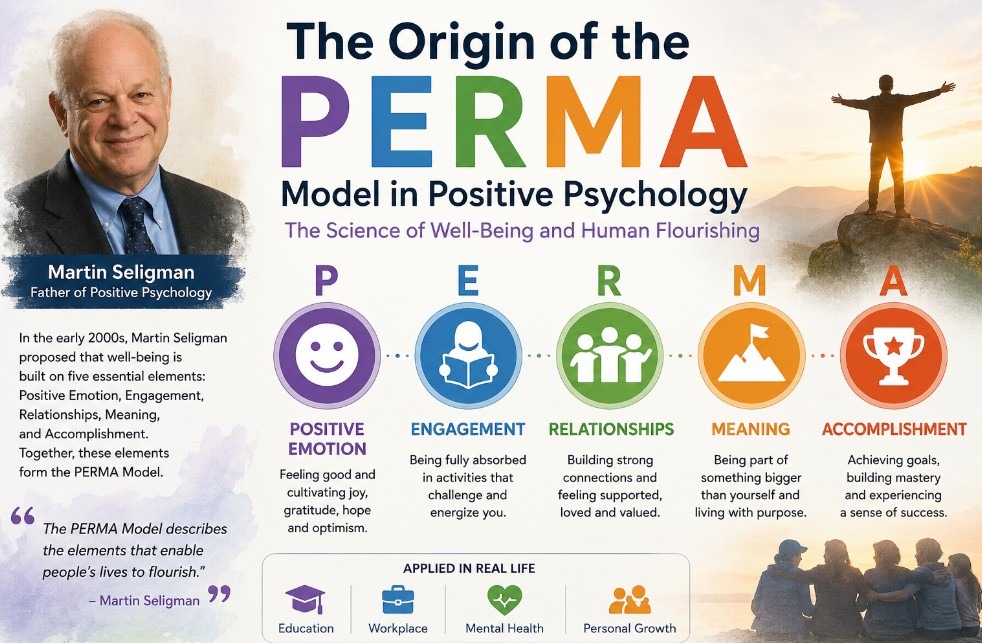

Introduction: The Connection of PERMA & Positive Psychology
The Origin of PERMA Model began when Martin Seligman, the Father of Positive Psychology, suggested that Positive Emotion, Engagement, Relationships, Meaning, and Accomplishment (PERMA) are elements that make up one’s well-being (Seligman, 2018).
According to Seligman, the PERMA Model is prescriptive; it does not dictate choices or values to people but describes the elements that enable people’s lives to flourish (Maguire, 2020). This article explores real-life applications of positive psychology, with a focus on the PERMA Model.
What is Positive Psychology?
As the former president of the American Psychological Association (APA) in 1998, Seligman and his colleagues launched a new field of research focusing on enhancing people’s well-being; the field of Positive Psychology (Maguire, 2020). According to Ackerman, Positive Psychology is a scientific approach to studying human thoughts, feelings, and behaviour, focusing on their strengths rather than weaknesses and on building a good life rather than repairing the bad (2018). As a field, it spends much of its time thinking about topics such as optimism, life satisfaction, happiness, well-being, gratitude, compassion, self-esteem and confidence, hope, and elevation (Ackerman, 2018).
Positive Psychology led to empirical research on happiness as a cause of desirable outcomes at work, school, in health, in relationships, and in aging (Seligman, 2018). It is now clear that happiness also leads to desirable outcomes: boosts immune system functioning and leads to fewer cold symptoms, is associated with taking fewer sick days, is associated with better health behaviours, predicts longevity, predicts gains in income, leads to better performance in companies, predicts advancement at work, etc. (Seligman, 2018).
A Deeper Dive into PERMA
Origin of the PERMA Model is rooted in Positive Psychology, and it is a combination of elements that promote well-being, which may be increased by increasing the PERMA elements (University of Tennessee, 2025; Basistha & Bhuyan, 2025; Brewerton, 2021):
- Positive Emotion: Subjective reports of happiness, hope, joy, and satisfaction. Happiness is a necessary component of improving well-being, as it also helps foster resilience and enhance mental well-being. For example: Take the time to reflect on positive experiences and feelings you have had, so that you can recall how those experiences looked, felt, smelled, and tasted.
- Engagement: Refers to focus, interest, or absorption in an activity. This is when someone completely commits to their abilities and attention to a difficult endeavour. Deep involvement in pursuits that play to one’s strengths and create a “flow” experience, which is so fulfilling that the task itself becomes the reward. For example, use your strengths more often to enjoy what you do, and craft your role and career around them.
- Relationships: Well-being is significantly influenced by feeling loved, supported, and respected by others. This includes closeness and connection with family, friends, and colleagues. For example: Keep in touch with the people who matter to you, and only keep those who reciprocate the same positive energy.
- Meaning: Finding meaning in life is essential to well-being because it motivates people to work towards their objectives. It is the belief in something larger than oneself and may be derived from religion, spirituality, or advocacy. To have meaning is to have purpose and a direction. For example: Become more involved in a cause or organization that matters to you.
- Accomplishment: Refers to pursuits, mastery, and effectiveness in achieving objectives and tasks throughout life, often requiring perseverance and resilience, and may include academics, athletics, or a career. For example: Draw on your strengths to overcome a challenge or attain a goal; make SMART goals. Honouring successes and reflecting on them can support a positive self-image and inspire continued goal pursuit.
The PERMA Model for Students
According to Bux, the PERMA Model may provide a useful lens for viewing the challenges faced by student veterans (i.e., any student who is a current or former member of the active-duty military, the National Guard, or the Reserves) or by students with mental health concerns (2021). Essentially, it is equally, if not more, effective as a tool for understanding why students succeed, and the five elements of the PERMA Model should be examined more carefully among students who succeed academically to help other students succeed as well (University of Tennessee, 2025; Bux, 2021):
- Positive Emotions: When students are supported by positive institutional experiences that strengthen their self-esteem and self-efficacy, they overcome the negative effects attributed to at-risk factors. Model how to give positive peer-to-peer feedback; Encourage students to keep a gratitude journal; and teach positive self-talk
- Engagement: Implement active learning activities, encourage their voices, and provide reflection prompts to help them identify their strengths. For example: “A strength that I used this week was ___., A strength that I learned this week was ____ A strength I am currently developing is ___.”
- Relationship: Have students establish ground rules, embedding collaborative learning, and using icebreakers to build rapport. Help connect students to others and opportunities through:
○ Campus resources
○ On or off-campus extracurricular activities
○ On or off-campus volunteering
- Meaning: Can include reflection exercises on learning and skill development throughout the academic journey, pictures of learning experiences, completed projects, poetry, art, and the connection between extracurricular activities and courses. Exploratory processes help students select studies that align with their interests and strengths: ○ Reflective Journaling; ○ Concept Mapping and○ EPortfolios.
- Accomplishment: Through discussions of past achievements, design educational plans with students, and encourage them to raise their ambitions rather than settle for the status quo. Help students find a medium to showcase their achievements through awards, certificates, training, internships, and competitions.
○ Set clear student learning outcomes.
○ Set their own SMART goals.
○ Celebrate and acknowledge their achievements.
Connecting the PERMA Model to the Workplace
Those who are employed may discover greater meaning in their life as a result of the sense of purpose and contribution that comes with their work. According to Basistha and Bhuyan, life satisfaction occurs when people feel more fulfilled and have a greater sense of purpose in life when they engage in work they are fully interested in (2025).
Current research shows that employment status has a substantial impact on engagement, meaning, accomplishment, and health. This is most likely also the reason why feeling accomplished at work reduces feelings of rage, anxiety, and loneliness. Higher performance levels among employed individuals may be related to the achievement and recognition that often accompany employment. The significant disparity in health suggests that a person’s work position affects both their physical and emotional well-being, with employed people likely enjoying better access to healthcare and living healthier lifestyles associated with steady employment (Basistha & Bhuyan, 2025).
Case Study: Applying the PERMA Model in the Mental Health Field.
The principal author of the study was assigned to look after Fred (not his real name) on a work placement. In the second week of the placement, Fred started showing negative behavioural attitudes towards other patients and pushing boundaries. The implementing interventions that were used were specifically Positive Emotion and Meaning; however, the results of these interventions also bled to the other elements as well. In no particular order, the following application of the PERMA Model occurred (Chisale & Phiri, 2022):
- Positive Emotion: Positive feedback from his key nurse pleased him and encouraged him to continue his treatment.
- Engagement: He was commended for his participation in quizzes, pools, watching TV, and spending time in communal areas chatting with his peers.
- Relationships: He encouraged other patients to find their own path to recovery, supported by the Multidisciplinary Team (MDT).
- Meaning: As a result of engaging in these activities, Fred became a champion of therapeutic activities.
- Accomplishments: As a result, he became involved in planning his care and setting goals. He asked MDT for support with more therapeutic activities to occupy himself when he felt distressed or anxious.
Conclusion: A little PERMA goes a long way!
From theory to practice, Origin of the PERMA Model has come a long way. Whether it is personal, for school, or for the workplace, anyone can apply this Model in their lives in simple, easy ways that can yield great results. The elements of the PERMA Model of Positive Psychology, as showcased in the case study, can improve mental health and well-being and should therefore be encouraged (Chisale & Phiri, 2022).
References
- Ackerman, C. (2018). What is positive psychology & why is it important? PositivePsychology.com. https://positivepsychology.com/what-is-positive-psychology-definition/
- Basistha, B. & Bhuyan, K. (2025). The PERMA Model in Practice: Exploring Life Satisfaction and Wellbeing. ResearchGate, 6(1), 463–473. https://www.researchgate.net/publication/387894337_The_PERMA_Model_in_Practice_ Exploring_Life_Satisfaction_and_Wellbeing
- Brewerton, P. (2021). What is the PERMA model of positive psychology? Strengthscope. https://www.strengthscope.com/podcasts/what-is-the-perma-model-of-positive-psycholog y
- Bux, S. (2021). PERMA as a Model for Student Success. nacada.ksu.edu. https://nacada.ksu.edu/Resources/Academic-Advising-Today/View-Articles/PERMA-as-a -Model-for-Student-Success
- Chisale, E., & Phiri, F. M. (2022). PERMA Model and Mental Health Practice. Asian Journal of Pharmacy, Nursing and Medical Sciences, 10(2). https://doi.org/10.24203/ajpnms.v10i2.7015
- Durant, Z. (2017). Silhouette photo of man on cliff during sunset. Unsplash. https://unsplash.com/photos/silhouette-photo-of-man-on-cliff-during-sunset-_6HzPU9Hy fg
- Maguire, L. G. (2020). The PERMA Model of Wellbeing. Human Performance. https://humanperformance.ie/the-perma-model/
- Seligman, M. (2018). PERMA and the building blocks of well-being. The Journal of Positive Psychology, 13(4), 333–335. https://doi.org/10.1080/17439760.2018.1437466 Seligman, M. (2019).
- Positive Psychology: A Personal History. Annual Review of Clinical Psychology. 15:1-23. https://doi.org/10.1146/annurev-clinpsy-050718-095653 University of Tennessee, Knoxville. (2025).
- PERMA: Fostering a Well-being Classroom. Teaching & Learning Innovation. https://teaching.utk.edu/wp-content/uploads/sites/78/2022/02/PERMA-Fostering-a-Well Being-Classroom-1.pdf