


Introduction
If you run a healthcare business, you’re probably very good at looking after everyone except yourself.
Maybe you run a private clinic, manage a multidisciplinary practice, or you’re growing a bigger healthcare company. Either way, the days blur together fast: patient decisions, staff who need direction, regulations that never stop shifting, invoices, rotas, and somewhere in there, an attempt at an actual personal life, although a meaningful work, It’s also exhausting in ways that don’t always show up until later.
A lot of healthcare professionals wear exhaustion like a badge of honour. “Once we’re fully staffed, I’ll slow down.” “Once this new service is up and running, things will calm down.” “Once the paperwork clears, I’ll breathe.” That moment rarely shows up on schedule. Instead, stress just becomes the background noise of the job, until feeling stretched thin starts to feel completely normal.
This is exactly where emotional balance techniques earn their keep. They’re practical, research-backed habits that help you move through pressure with a bit more clarity, steadiness, and self-compassion.
Positive psychology has quietly changed how we think about wellbeing. Rather than asking “how do we stop people burning out,” it asks something more useful: what helps people flourish, even when life doesn’t slow down? For healthcare entrepreneurs specifically, that reframe matters. Taking care of your own wellbeing is one of the smartest investments you can make in your patients, your team, and the future of what you’ve built.
Emotional Balance Is a Leadership Skill
Imagine two clinic owners, faced with the exact same crisis. A valued team member quits with no notice. The appointment book needs untangling. Patients are annoyed. Suddenly there’s twice the work and half the capacity to do it.
One owner snap at people, spirals into overwhelm, and makes rushed calls all afternoon. The other feels just as stressed, but pauses before reacting, talks to the team calmly, and starts working the problem practically.
Neither person is under less pressure. The difference is that one of them has built stronger emotional regulation.
Psychologists tend to describe emotional balance techniques as being able to notice what you’re feeling without letting that feeling drive every decision you make. It isn’t about staying cheerful no matter what, or swallowing frustration until it disappears. It’s about responding on purpose, instead of just reacting.
That distinction matters enormously in healthcare, where emotions are running high pretty much constantly. Patients show up anxious. Colleagues are stretched. Hard conversations happen weekly, if not daily. When leaders don’t have a way to manage their own emotional load, that tension has a habit of spreading through the whole organisation.
The good part: emotional balance isn’t a fixed trait you either have or don’t. Like any clinical skill, or any leadership skill, it’s something you build with practice.
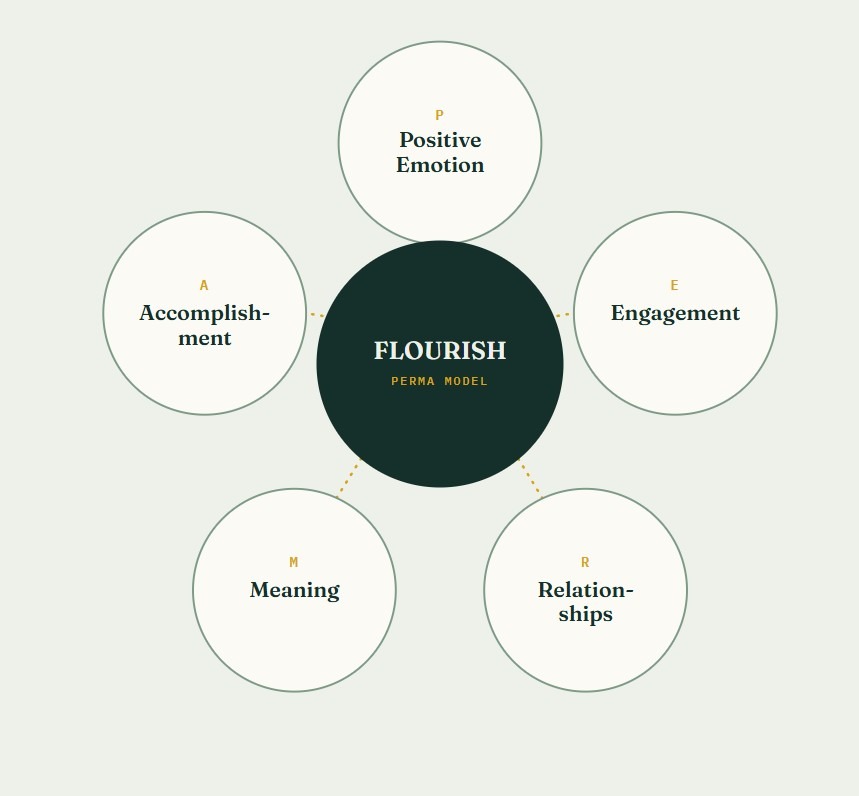
One of the more influential frameworks here comes from Martin Seligman’s PERMA model of wellbeing. Instead of treating mental health as simply “not stressed,” PERMA argues that flourishing comes from five things working together:
- Positive Emotion — moments of genuine joy, gratitude, or hope
- Engagement — being properly absorbed in work that matters to you
- Relationships — real, supportive connections with colleagues, patients, and the people at home
- Meaning — a sense that your work adds up to something beyond the day-to-day
- Accomplishment — noticing progress, rather than only chasing the next target
For anyone running a healthcare business, these five pillars work as a practical map for protecting your wellbeing without stepping back from the demands of leading.
If you’ve ever finished a day physically wiped out but strangely unsatisfied, it might not be because you didn’t do enough. It might be because one of these pillars has quietly gone unattended for a while.
Emotional Balance Techniques You Can Actually Use Today
One of the biggest myths about wellbeing is that it takes more time than a busy clinician or business owner must spare. In practice, it’s usually built from small, deliberate habits that slot into a day you’re already living.
Here are a few emotional balance techniques worth trying, all grounded in psychological research, that hold up even on your most chaotic days.
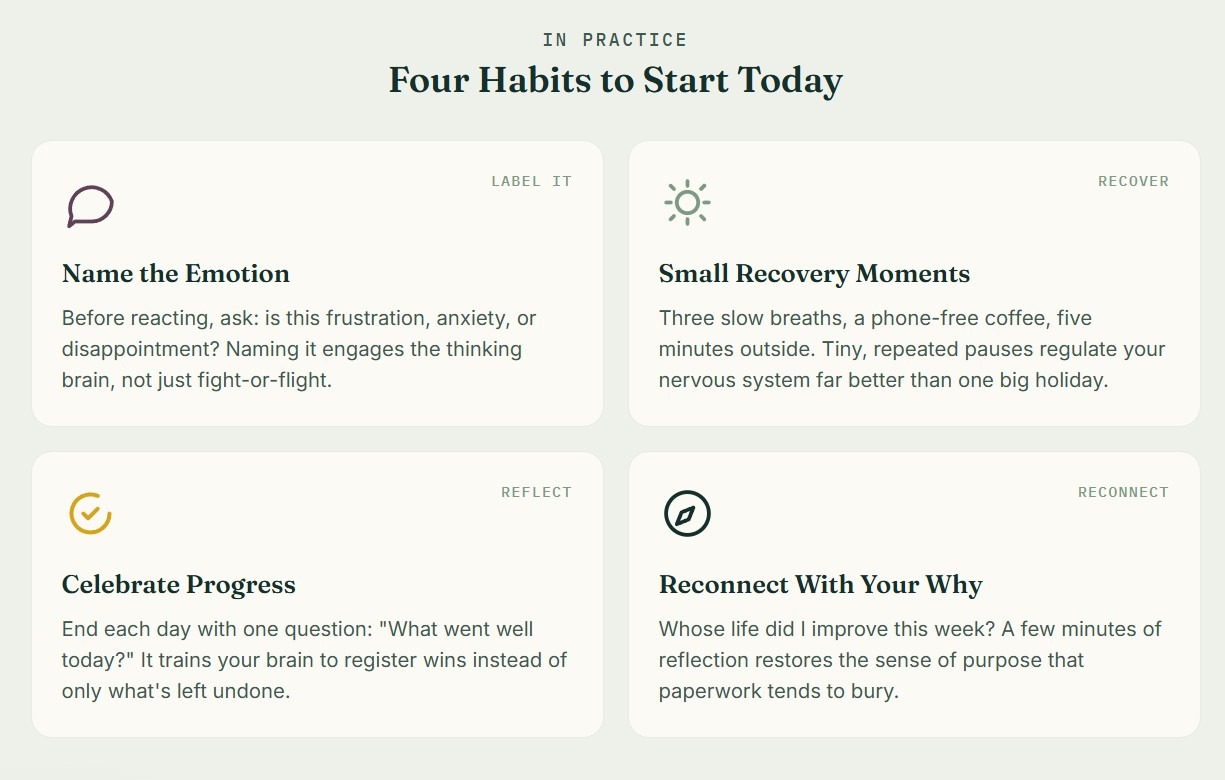
- Name What You’re Feeling — Don’t Just Label It “Stress”
Ever caught yourself saying “I’m just stressed” without stopping to ask what that means?
Psychologists call this emotional labelling, simply putting a specific name to what you’re feeling. Studies suggest that naming an emotion can take some of the intensity out of it, because it shifts activity toward the brain’s reasoning centres and away from pure fight-or-flight mode.
Next time something goes sideways, pause for a second and ask yourself:
- Is this frustration?
- Is this anxiety?
- Is this disappointment?
- Is this just plain overwhelm?
That tiny pause creates a gap between the feeling and your response, and that gap is often where better decisions get made.
- Build in Small Recovery Moments
Most healthcare entrepreneurs save all their rest for holidays. Unfortunately, that’s not how our brains work.
Think of your energy like a phone battery. Charge it once every few months and it’s going to die on you at the worst possible time.
Instead, scatter small recovery moments through the day:
- Three slow breaths before you walk into your next appointment
- Coffee without your phone in hand
- Five minutes outside between meetings
- A stretch after hours hunched over paperwork
None of this look like much on their own. Strung together over weeks, though, they genuinely help regulate your nervous system and sharpen your focus.
- Celebrate Progress, Not Just Perfection
Healthcare professionals tend to hold themselves to brutally high standards. Ambition is fine, but chasing perfection nonstop is a fast route to burnout.
At the end of each day, try asking just one question:
“What went well today?”
Maybe a patient thanked you for really listening. Maybe your team pulled together on a tricky problem. Maybe you finally cleared that task that’s been sitting on your list for three weeks.
Noticing progress trains your brain to register wins, instead of only cataloguing what’s still undone.
- Reconnect With Your “Why”
As a business grows, it’s easy for admin, staffing headaches, finances, and compliance to bury the actual reason you got into healthcare in the first place.
Set aside a few minutes each week for questions like:
- Whose week did I make better?
- What part of this work gave me real purpose?
- How has what I’ve built helped the people around me?
These small check-ins feed directly into the Meaning piece of the PERMA model, and they’re a good reminder that the work is bigger than spreadsheets and staff rotas.
A Fictional Story: How Dr Maya Found Her Way Back
Here’s a fictional example, but one plenty of healthcare entrepreneurs will recognise.
When Dr Maya opened her physiotherapy clinic, she was thrilled. She’d spent years imagining a practice where patients felt truly cared for, and within a couple of years, it was thriving.
From the outside, everything looked great. The diary was always full. Her team respected her. Patient feedback was glowing.
Behind the scenes, though, Maya was quietly falling apart.
She skipped lunch most days. She answered emails well into the evening. Weekends were spent worrying about staffing, cash flow, and patient outcomes. She kept telling herself that once things settled, she’d finally ease off.
However, the business kept growing, and so did the pressure.
Then one afternoon, she snapped at a receptionist over something minor, and it stopped her cold.
She wasn’t turning into a bad leader.
She was just running on empty.
Instead of pushing harder, Maya started weaving PERMA into her routine in small, manageable ways.
Each morning, she read one positive patient testimonial before opening her inbox, a two-minute reminder of why she’d started the clinic at all.
She blocked out thirty minutes, twice a week, purely for strategic thinking instead of constant firefighting.
She introduced weekly team check-ins where everyone shared one win before raising any problems. Slowly, the whole atmosphere in the clinic shifted toward something more collaborative.
She stopped measuring success purely by revenue or patient numbers, and started noticing personal wins too, leaving on time twice a week, eating lunch away from her desk, making it to her daughter’s school concert without checking her phone once.
Three months later, something had changed.
The workload hadn’t gotten any lighter, but Maya had.
She stayed calmer when things went wrong. Her team noticed she smiled more, delegated with more confidence, and was present in conversations rather than half-elsewhere.
Maybe most importantly, she found her way back to the sense of purpose that got her into healthcare in the first place.
Maya’s story is fictional, but the underlying research isn’t. Studies in positive psychology consistently show that investing in wellbeing doesn’t just help the individual, it ripples out into better leadership, stronger teamwork, more creativity, and better organisational performance overall.
Flourishing Starts With You
Running a healthcare business will probably never feel easy. There will always be surprises, hard conversations, and days when everything hits at once.
Protecting your wellbeing was never about waiting for life to get quieter. It’s about the small choices you make every single day that support your mental and emotional health.
The most effective emotional balance techniques are the simple habits that let you pause before reacting, stay connected to your purpose, notice your progress, and invest in the relationships that matter.
References
- Barbara L. Fredrickson (2001). The role of positive emotions in positive psychology: The broaden-and-build theory of positive emotions. American Psychologist, 56(3), 218–226. https://doi.org/10.1037/0003-066X.56.3.218
- Jon Kabat-Zinn (2003). Mindfulness-based interventions in context: Past, present, and future. Clinical Psychology: Science and Practice, 10(2), 144–156. https://doi.org/10.1093/clipsy.bpg016
- Carol D. Ryff (2014). Psychological well-being revisited: Advances in the science and practice of eudaimonia. Psychotherapy and Psychosomatics, 83(1), 10–28. https://doi.org/10.1159/000353263
- Martin E. P. Seligman (2011). Flourish: A visionary new understanding of happiness and well-being. Free Press.
Frequently Asked Questions
- What are emotional balance techniques? They’re practical strategies for recognising, regulating, and responding to emotions in healthy ways, things like mindfulness, emotional labelling, gratitude, self-reflection, and purposeful recovery breaks.
- How can healthcare entrepreneurs improve emotional wellbeing? By building small recovery moments into the day, staying connected to their sense of purpose, nurturing supportive relationships, practising gratitude, and leaning on frameworks like PERMA.
- Why is the PERMA model relevant to business owners? It gives entrepreneurs a structure for sustainable wellbeing built on five things : Positive Emotion, Engagement, Relationships, Meaning, and Accomplishment, all of which feed into resilience, better leadership, and lasting professional satisfaction.