
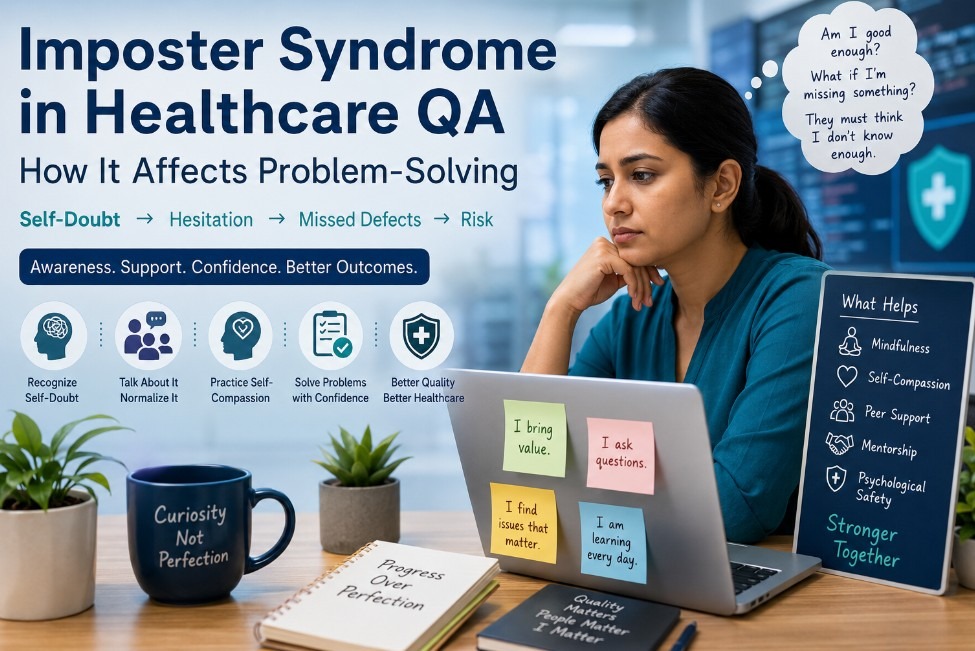

A human-centred perspective on confidence, psychological safety and quality assurance in healthcare technology
Introduction
Imagine spending hours testing a healthcare application, finding a potential defect, and then stopping yourself from reporting it. What if I have misunderstood the requirement? What if a colleague thinks I do not know what I am doing? What if this is not really a bug?
For many technology professionals, particularly those working in healthcare quality assurance (QA), these thoughts can feel surprisingly familiar. Imposter syndrome describes persistent self-doubt despite evidence of competence. In a QA environment, that self-doubt can affect the very behaviours that make quality assurance effective: questioning assumptions, investigating uncertainty, communicating concerns and making timely decisions.
Why imposter syndrome matters in healthcare QA
Healthcare technology is complex and consequential. QA professionals may work with electronic health records, patient portals, clinical decision-support systems, medical devices, laboratory platforms and integrations between multiple systems. A defect may affect a clinical workflow, data integrity or patient safety.
This high level of responsibility can make uncertainty feel threatening. A tester may believe they must be completely certain before raising a concern. Yet QA is not about knowing everything. It is about systematically investigating uncertainty.
Research describes an ‘imposter cycle’ in which self-doubt can lead either to over-preparation or procrastination. Both patterns can consume time and interfere with effective problem-solving. A 2025 systematic review and meta-analysis of health service providers also found that imposter experiences can be associated with occupational and psychological difficulties, including reluctance to speak up. A 2026 study of nurse managers similarly reported a negative relationship between impostor characteristics and decision-making self-efficacy.
How imposter syndrome can affect problem-solving
Second-guessing
A tester may identify unusual behaviour but dismiss it because they assume somebody more experienced has already considered it. A healthier approach is: ‘I have noticed something unusual. Let me investigate it systematically.’
Fear of speaking up
QA professionals often work across developers, product managers, clinicians, data specialists and compliance teams. Feeling like an outsider can make a basic question feel embarrassing. Yet asking questions is part of quality assurance.
Perfectionism
Repeatedly checking a test can be valuable when risk warrants it. When checking is driven primarily by fear of being wrong, however, it can become inefficient and exhausting. A useful question is: ‘Am I being thorough because the risk requires it, or because I am afraid of being wrong?’
Avoiding difficult problems
An unfamiliar integration or technically challenging defect may trigger the thought that someone more qualified should handle it. Avoidance can reinforce the original self-doubt because the person never discovers what they can learn or accomplish.
A human problem inside a technical role
Behind every test script, defect ticket and release decision is a person. QA professionals experience uncertainty, fatigue, pressure, pride and fear. This human dimension matters particularly in healthcare because professionals know their work can affect clinicians and patients.
Imposter syndrome should not be treated as a diagnosis or as proof that someone lacks competence. It is better understood as an experience of self-doubt that can be influenced by individual thinking patterns and by the culture around the person.
Evidence-informed interventions
The most useful response is not simply to tell a QA professional to ‘be more confident’. Confidence can be developed through structured reflection, supportive relationships and psychologically safer working environments.
| Level | Strategy | Description |
| Individual (CBT) | Cognitive restructuring | Challenge negative self-talk and set realistic, evidence-based goals. |
| Individual | Mindfulness & self-compassion | Build awareness and respond to mistakes with greater kindness and perspective. |
| Team | Blameless reviews & mentoring | Create a collaborative testing culture with peer support and shared learning. |
| Team | Open discussion of doubts | Normalise imposter feelings through respectful group conversation. |
| Organisational | Training & workshops | Provide CBT-informed, resilience and psychological-safety training. |
| Organisational | Mentorship & recognition | Formalise mentoring relationships and recognise contribution and progress. |
| Organisational | Psychological-safety policies | Use supportive feedback, clear expectations and leadership behaviours that encourage speaking up. |
Used appropriately, these interventions can help testers move from fear-driven checking and hesitation towards more evidence-based, collaborative problem-solving. They should complement—not replace—sound QA processes, clinical safety procedures and professional support where needed.
Fictional case study: Alex’s journey
Important: The following case study is entirely fictional and is provided for illustration.
Scenario
Alex, a software QA tester in a hospital IT department, joins a project testing a new electronic health record (EHR) interface. Although Alex has solid training, they worry that colleagues expect a seasoned expert. Early in the project, Alex over-analyses straightforward test cases and hesitates to report a potentially critical issue involving medication-dosage logic because of concern that it might be a false alarm.
What Alex experiences
Alex spends hours rewriting test scripts, contributes very little in meetings and delays some test cases because of fear of making a mistake. A synchronisation issue remains unreported for several days, affecting a clinical workflow. The problem is not a lack of technical ability; it is the effect of self-doubt on professional behaviour.
Interventions
Alex’s manager pairs them with a senior QA mentor and provides access to a workshop covering imposter experiences and CBT-informed techniques. Alex starts a validation log to record successful tests, useful questions and positive feedback. The mentor encourages Alex to ask clarifying questions in design meetings. The team also introduces short daily ‘bug huddles’, making it easier to raise concerns early without framing defects as personal failures.
Alex’s fictional timeline
| Period | Progress |
| May 2025 | Joins QA team; excited but experiences early doubts. |
| June 2025 | Becomes hesitant in meetings and over-prepares because of fear of mistakes. |
| July 2025 | Begins mentoring and an imposter-awareness workshop; learns CBT-informed reframing. |
| August 2025 | Uses more balanced self-talk and peer reviews. |
| September 2025 | Confidence grows; Alex actively identifies and reports defects. |
| October 2025 | Alex leads part of the QA phase; issues are caught before release and the team recognises the contribution. |
Interpreting the fictional outcomes
In this fictional scenario, Alex’s defect-finding rate increases by 40% and the team’s defect backlog falls by 25% by October 2025. Alex also reports substantially less anxiety and greater confidence in raising concerns. These figures are illustrative, not empirical findings, and should not be interpreted as a guaranteed effect of any particular intervention.
The important change is behavioural: Alex learns that they do not need perfect certainty before raising a responsible question. Their professional role is to observe, investigate, document and communicate.
What healthcare technology leaders can do?
- Invite QA professionals to challenge requirements and assumptions.
- Use blameless, learning-focused reviews rather than blame-oriented responses.
- Recognise good questions and thoughtful investigation, not only successful defect discoveries.
- Pair less experienced testers with supportive mentors.
- Make it acceptable to say, ‘I do not know yet.’
- Distinguish a learning mistake from negligence or a process failure.
- Maintain sustainable workloads and encourage appropriate breaks.
- Give people opportunities to explain their reasoning, not merely their conclusions.
From self-doubt to constructive curiosity
For healthcare QA professionals, confidence is not the absence of doubt. Sometimes the most responsible person in the room is the one willing to say, ‘I am not sure. Can we look at this again?’ That sentence can be the beginning of better problem-solving.
Imposter syndrome can make capable people question whether they belong and whether their observations matter. But a QA professional does not need to have every answer to provide enormous value. They need to notice, ask, investigate and communicate—and to recognise that competence is not measured by never being uncertain, but by knowing how to work responsibly with uncertainty.
Conclusion
Healthcare technology needs technically rigorous systems, but it also needs people who feel able to question, collaborate and speak up. Addressing imposter syndrome is therefore not simply about making individuals feel better. It can be part of building healthier, more psychologically supportive teams in which professional judgement is more readily expressed.
At PERMA Integrated Health, we believe healthier technology ecosystems begin with healthier, more psychologically supported people. When professionals develop self-awareness, confidence, connection, meaning and resilience, they are better positioned to solve complex problems—and to contribute to technology that ultimately serves human wellbeing.
References
- Huecker, M. R., Shreffler, J., McKeny, P. T., & Davis, D. (2023). Imposter phenomenon. In StatPearls. StatPearls Publishing. https://www.ncbi.nlm.nih.gov/books/NBK585058/
DOI: Not assigned.
Link: NCBI Bookshelf – Imposter Phenomenon - Salari, N., Hashemian, S. H., Hosseinian-Far, A., Fallahi, A., Heidarian, P., Rasoulpoor, S., & Mohammadi, M. (2025). Global prevalence of imposter syndrome in health service providers: A systematic review and meta-analysis. BMC Psychology, 13, 571. https://doi.org/10.1186/s40359-025-02898-4
DOI: https://doi.org/10.1186/s40359-025-02898-4
Link: BMC Psychology article - Mohamed, A. I. A. E. K., Atalla, A. D. G., Ali, R. M. N., Abdel Rahman, A. A. O., Mohammad, M. Z., Elbaky, M. M. M., & Mohamed, S. H. K. A. (2026). Unearthing the impact of impostor syndrome on decision self-efficacy among nurse managers. SAGE Open Nursing, 12, 1–11. https://doi.org/10.1177/23779608251413343
DOI: https://doi.org/10.1177/23779608251413343
Link: SAGE Open Nursing article - Washington State Hospital Association. (2026, March 19). Impostor syndrome is quietly undermining your team’s performance – Sign up for the Healthcare Executive Leadership Program.
DOI: Not applicable.
Link: Washington State Hospital Association article
Editorial note: This article is for educational and professional wellbeing purposes. Imposter syndrome is not a formal mental-health diagnosis. If self-doubt is causing significant distress or affecting daily functioning, appropriate professional support should be considered.