

Introduction
Healthcare technology is often discussed in terms of innovation, efficiency, interoperability, artificial intelligence and patient outcomes. Yet behind every digital health solution are people: developers writing code, designers shaping experiences, clinicians adapting to new systems, product managers making difficult decisions and patients learning to trust technology with deeply personal information.
Perhaps one of the most important questions for the future of healthcare technology is therefore not simply What can technology do? but How can we create technology that supports human flourishing?
This is where positive psychology in digital health offers an intriguing perspective.
Positive psychology focuses not only on reducing distress or dysfunction, but also on understanding the conditions that help people thrive. Seligman’s PERMA framework describes five dimensions associated with wellbeing: Positive Emotion, Engagement, Relationships, Meaning and Accomplishment.
Applied thoughtfully, these principles can influence both sides of digital health: the wellbeing of the people who create and deliver technology and the experience of the people who use it.
Beyond making technology more efficient
Healthcare technology can be transformative, but technology alone does not guarantee better experiences.
A digital system can be technically sophisticated and still leave a clinician frustrated. A wellness application can contain hundreds of features and still fail to motivate a person to return. A patient portal may provide access to information while leaving the person feeling overwhelmed rather than empowered.
This is because healthcare is fundamentally human.
Research has suggested that digital health technology can sometimes function as a work resource rather than simply another work demand. In a study of more than 7,000 Australian physicians, digital health technology use was associated with higher job satisfaction and better work-life balance, although the researchers appropriately noted that the findings should be interpreted cautiously because the study was observational.
The lesson is not that technology automatically improves wellbeing. Rather, how technology is designed, introduced and experienced matters.
Positive psychology provides one way of thinking about that experience.
What does PERMA look like in digital health?
The five PERMA elements can be translated into surprisingly practical design questions.
Positive Emotion asks whether an experience creates moments of hope, reassurance, gratitude or confidence rather than constant anxiety and information overload.
Engagement considers whether people can become meaningfully involved in an activity rather than simply clicking through endless prompts.
Relationships reminds us that technology should strengthen human connection rather than unintentionally replace it.
Meaning asks a deeper question: Why does this matter? For a healthcare professional, the answer might be reconnecting with the reason they entered healthcare. For a patient, it could be having enough energy to attend a daughter’s graduation or return to an activity they love.
Accomplishment gives people evidence of progress. Small, visible achievements can help transform a vague aspiration such as “I need to look after my health” into something tangible and achievable.
Importantly, these elements do not have to be treated as five separate features. They can become part of the philosophy underlying an entire product.
Case study: when the dashboard became a human story
Consider Maya, a fictional product manager working for a digital health company.
Her team had developed a sophisticated dashboard containing dozens of clinical indicators. The system was accurate, fast and highly configurable. Yet clinicians complained that it required too much interpretation.
During a redesign workshop, Maya asked an apparently simple question:
“What are we actually helping the clinician accomplish?”
The team realised that they had designed the product around data rather than decisions.
They redesigned the experience around three questions: What should I notice? What might it mean? What could I do next?
The dashboard became simpler. Important information was prioritised, explanations became clearer, and the system showed progress rather than merely presenting numbers.
The technology had not necessarily become more intelligent. The experience had become more meaningful.
That distinction is important.
Meaning may be the missing link
Among the PERMA elements, Meaning deserves particular attention in healthcare technology.
Digital health professionals can spend months working on a feature without ever seeing the person who ultimately benefits from it. Developers may know that a system processes thousands of records, but not that one particular improvement helped a clinician spend more time listening to a worried patient.
That distance can gradually weaken the sense of purpose.
Self-Determination Theory offers another useful lens here. Ryan and Deci identify autonomy, competence and relatedness as fundamental psychological needs associated with healthy motivation and functioning.
A healthcare technology environment that provides professionals with autonomy, opportunities to develop competence and genuine connection with the people affected by their work may therefore support more sustainable motivation.
Meaning does not require every employee to feel heroic. Sometimes it comes from making a small contribution to something considered worthwhile.
Case study: the engineer who met the person behind the feature
Daniel, a fictional software engineer, was becoming disengaged after months of working on a healthcare messaging system.
From his perspective, he was fixing tickets.
The organisation introduced a monthly “human impact session” in which engineers heard directly from clinicians and patients about how particular improvements affected their daily lives.
One clinician explained that a seemingly minor change had reduced the time required to locate an important patient message.
For Daniel, that changed the meaning of the work.
The task was still a task. But it was no longer just a task.
This illustrates an important principle for healthcare technology leaders: meaning can be designed into the working environment without manufacturing artificial motivation.
Sometimes people simply need a clearer line of sight between their work and its human consequence.
Designing for wellbeing, not dependency
There is also a cautionary side to positive psychology in digital health.
A wellbeing technology should not rely on endless notifications, guilt or gamification to keep people engaged. Engagement is not the same as dependency.
A person can be highly engaged with an application while becoming more anxious about their health.
Similarly, achievement should not become another source of pressure. Someone who misses a daily target should not feel that they have failed as a person.
The goal should be supportive technology, not technology that exploits psychological vulnerabilities.
This means giving users meaningful choice, explaining recommendations clearly, respecting privacy and creating opportunities to pause.
In other words, wellbeing should be treated as an outcome of the experience, not merely a marketing label.
From digital health to human-centred health
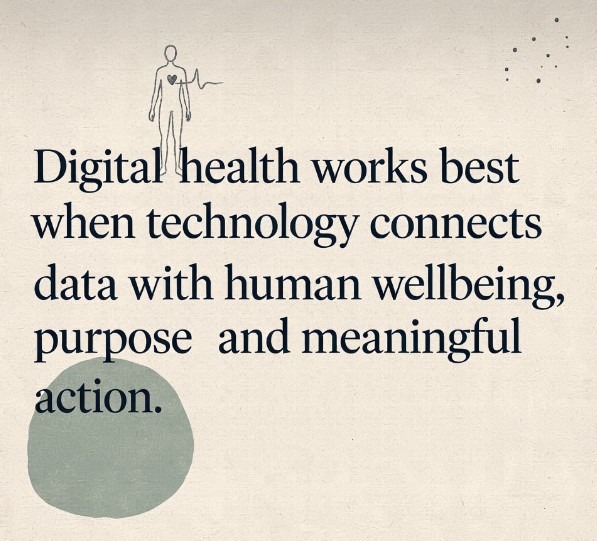
The future of healthcare technology may depend increasingly on our ability to connect data with meaning.
Biomarkers can tell us what is happening. Artificial intelligence can identify patterns. Digital platforms can coordinate information. But people still need to understand what that information means in the context of their lives.
A patient is more than a collection of measurements.
A clinician is more than a user of an electronic health record.
And a healthcare technology professional is more than the person who delivers the next feature.
This is where positive psychology in digital health becomes more than an academic concept. It offers a way to think about technology as part of a larger human ecosystem, one in which wellbeing, purpose, relationships and achievement matter alongside performance and efficiency.
The most meaningful healthcare technology may therefore not be the technology with the greatest number of features.
It may be the technology that helps people feel more informed, capable, connected and purposeful.
And perhaps that is the question worth asking before we build the next digital health solution:
Will this technology simply help people do more, or will it help people live better?
References
- Ryan, R. M., & Deci, E. L. (2000). Self-determination theory and the facilitation of intrinsic motivation, social development, and well-being. American Psychologist, 55(1), 68–78. https://doi.org/10.1037/0003-066X.55.1.68
- Seligman, M. E. P. (2011). Flourish: A visionary new understanding of happiness and well-being. Free Press.
- Zaresani, A., & Scott, A. (2020). Does digital health technology improve physicians’ job satisfaction and work-life balance? A cross-sectional national survey and regression analysis using an instrumental variable. BMJ Open, 10, e041690. https://doi.org/10.1136/bmjopen-2020-041690