

Introduction
Imagine opening a health app to improve your wellbeing. It asks you to complete a questionnaire, then another one. You connect your smartwatch, receive a health score, and get several recommendations.
Everything looks intelligent, but how do you feel? Perhaps informed, maybe motivated, or slightly overwhelmed.
This is an important question as healthcare becomes increasingly digital. We often talk about artificial intelligence, wearables, electronic health records, remote monitoring, and personalised health platforms. We talk about data, interoperability, and better outcomes.
However, there is another part of the conversation that deserves more attention in the sphere of digital health and wellbeing.
How does technology make people feel, behave, and live?
The World Health Organization describes digital health as the use of digital technologies to improve health. This includes a broad range of technologies, from mobile applications and telemedicine to artificial intelligence, connected devices and health information systems.
Technology can give people greater access to information and support, but technology alone does not create wellbeing.
The way technology is designed and experienced matters.
This is where positive psychology and the PERMA model can provide a useful human-centred perspective.
What is PERMA?
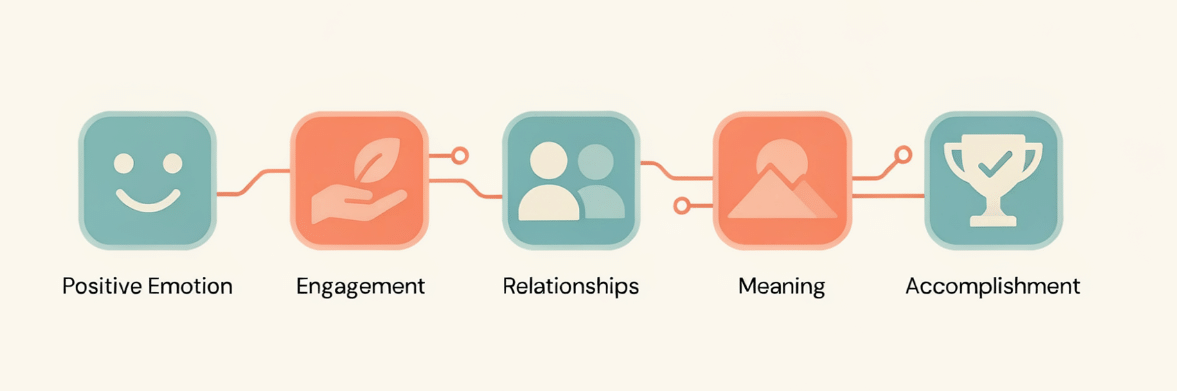
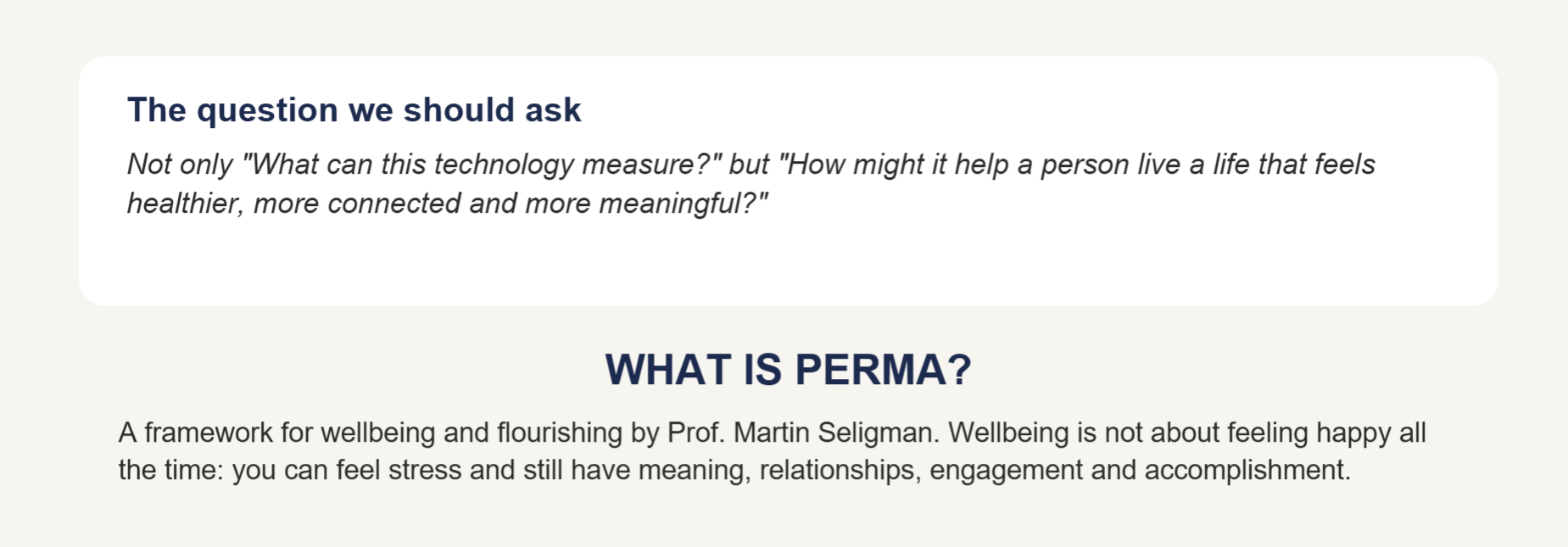
PERMA was coined by Professor Martin Seligman as a framework for understanding wellbeing and human flourishing.
The 5 elements are:
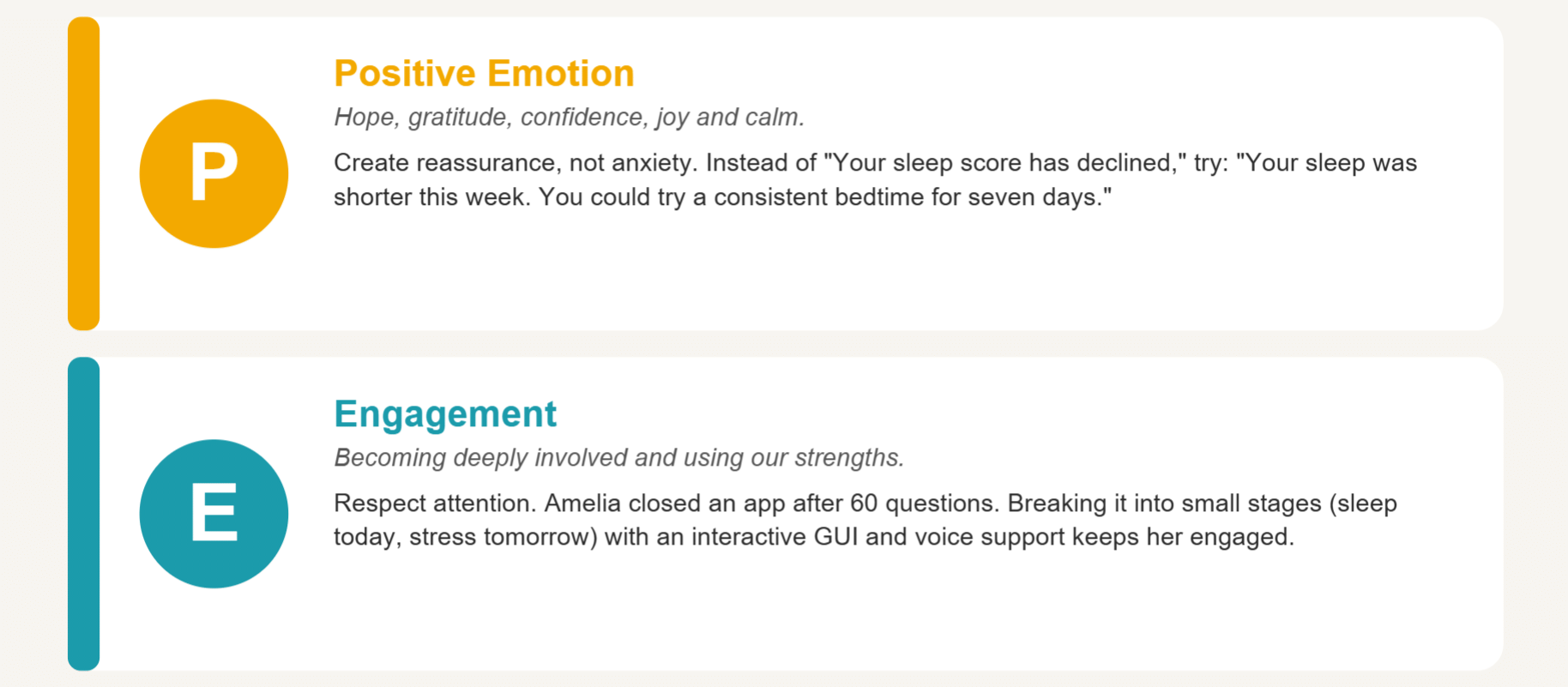
- P – Positive Emotion: experiences such as hope, gratitude, confidence, joy and calm.
- E – Engagement: becoming deeply involved in an activity and using our strengths.
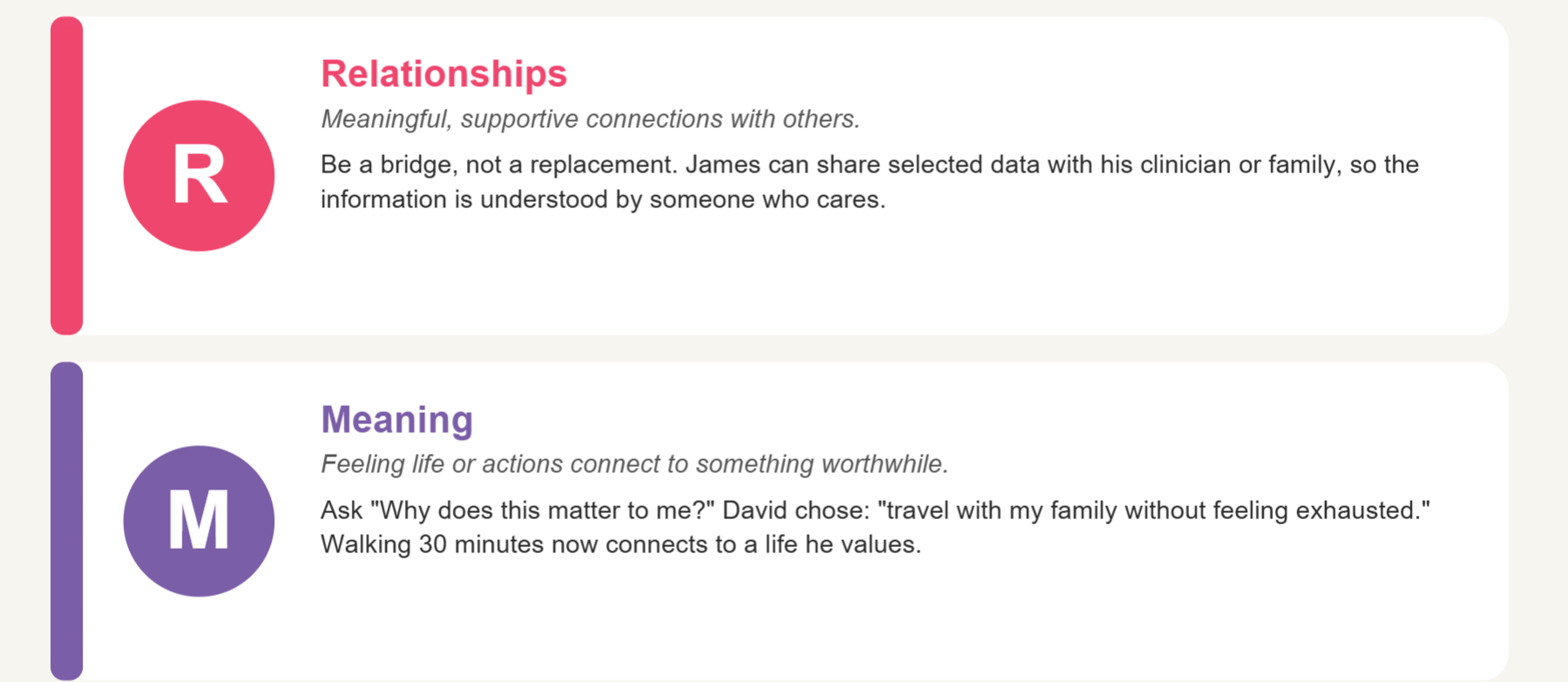
- R – Relationships: having meaningful and supportive connections with other people.
- M – Meaning: feeling that our lives or actions are connected to something bigger or worthwhile.
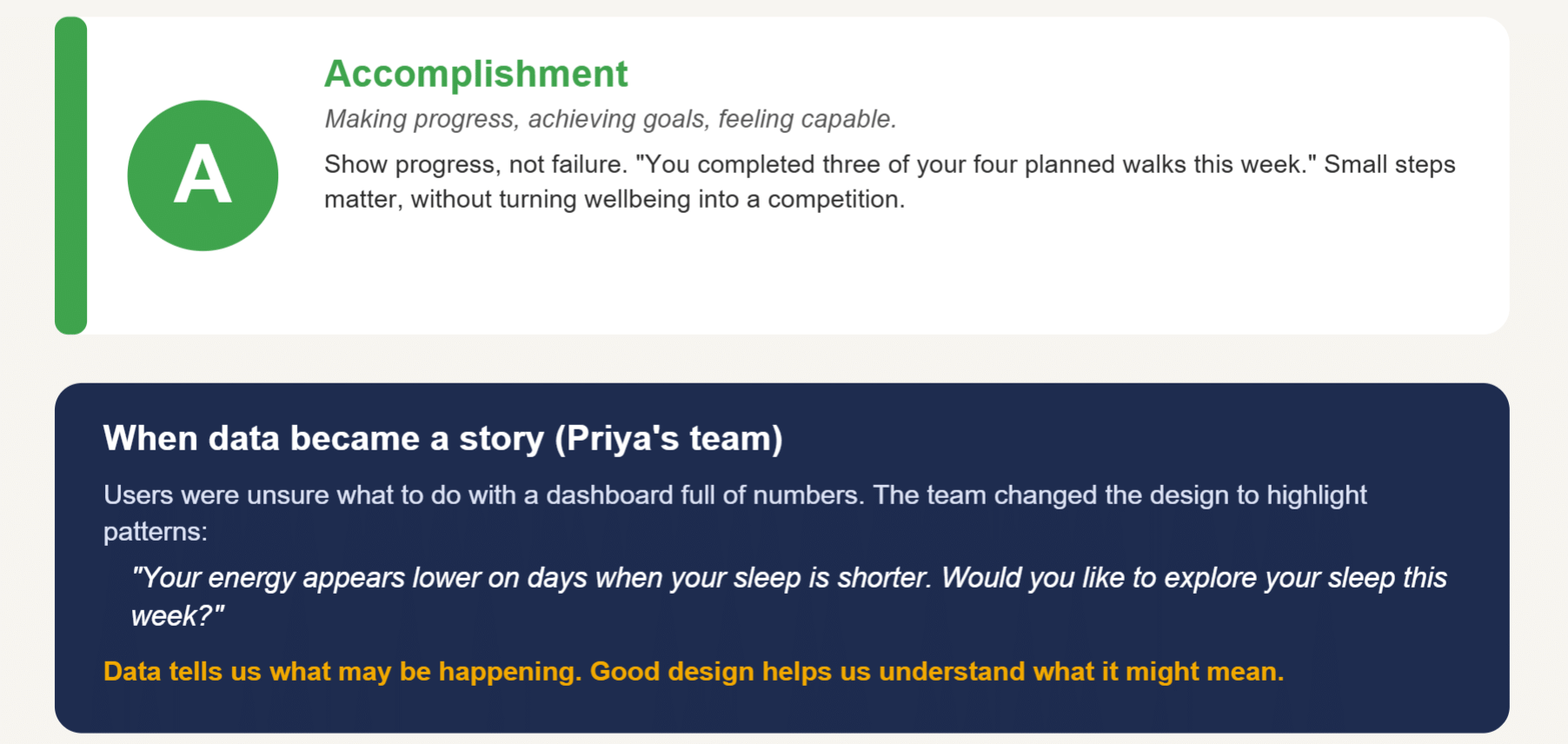
- A – Accomplishment: making progress, achieving goals and developing a sense of capability.
The important point is that wellbeing is not simply about feeling happy all the time.
A person may experience stress, disappointment or uncertainty and still have meaning, relationships, engagement and a sense of accomplishment.
The PERMA model therefore gives us a broader way of thinking about wellbeing.
Research into the PERMA-Profiler has also shown that these dimensions can be assessed separately, allowing wellbeing to be viewed as a multidimensional experience rather than a single score (Butler & Kern, 2016).
Why does this matter for digital health?
Digital health products are often designed around functionality.
- What should the application do?
- What information should it collect?
- What data should it display?
- What recommendation should it provide?
These are important questions.
However, we can add another layer:
What experience are we creating for the human being using it?
For example, a sleep application might tell someone that they slept for six hours and forty-two minutes.
That is useful information, but what happens next?
Does the person understand what they can do differently tonight?
Do they feel encouraged or judged?
Does the application help them understand why sleep matters to them personally?
Can they see progress without becoming obsessed with the number?
These questions move us from simply measuring health towards thinking about digital health and wellbeing as a human experience.
P – Positive Emotion: creating reassurance rather than anxiety
Health information can sometimes make people anxious.
A dashboard filled with red indicators, alerts and warnings may be technically accurate but emotionally difficult to use.
Positive emotion does not mean making everything cheerful or hiding difficult information.
It means considering whether the experience also creates hope, confidence and a sense that the person can take meaningful action.
For example, instead of simply saying:
“Your sleep score has declined.”
a system might provide context:
“Your sleep was shorter this week. If you would like to improve it, you could try keeping your bedtime consistent for the next seven days.”
The information remains honest, but the experience becomes more supportive.
E – Engagement: helping people participate
A health application cannot improve someone’s wellbeing if the person stops using it.
Engagement is therefore important, but engagement should not mean creating endless notifications or making an application deliberately addictive. Meaningful engagement happens when people feel that an activity is relevant to them.
Use Case 01: Making a Health App Easier to Engage With
Consider Amelia, a fictional 42-year-old professional.
She downloads a wellbeing application because she has been feeling tired.
The application initially asks her to complete 60 questions, and she closes it.
The problem is not necessarily that Amelia does not care about her health.
The problem may be that the experience asks too much, too soon.
A PERMA-informed approach might break the experience into smaller stages.
Today, Amelia answers a few questions about sleep. Tomorrow, she explores stress. Later, she reflects on relationships and purpose.
The technology gradually builds a picture of her experience rather than demanding everything at once. An interactive GUI and tech-enabled support, such as voice agents to aid Amelia in answering the questions, are also better means to ensure engagement with the app.
Good engagement respects attention.
R – Relationships: technology should not make healthcare more lonely
Healthcare is deeply relational.
Patients have relationships with doctors, nurses, therapists, family members and friends.
Technology can strengthen these relationships, but it can also unintentionally make healthcare feel more isolated.
Imagine James, a fictional 67-year-old who uses a remote monitoring platform after a period of poor health.
His wearable collects useful information about his activity and sleep.
But James also wants someone to understand what the information means.
A well-designed system might allow him to share selected information with his healthcare professional or family member, according to his preferences.
The technology becomes a bridge rather than a replacement for human connection.
This distinction matters.
The goal should not always be to automate the human interaction.
Sometimes the role of technology is to make the human interaction better.
M – Meaning: asking why health matters
Meaning is perhaps one of the most overlooked parts of digital health.
A person may know that exercise is good for them.
They may know they should sleep more.
They may know they need to manage stress.
But knowledge does not automatically create motivation.
Meaning asks a different question:
Why does this matter to me?
Consider David, a fictional 51-year-old father.
His health application recommends that he become more physically active.
Previously, he ignored similar advice.
This time, the application asks him what he would like to have more energy for.
David chooses:
“I want to be able to travel with my family without feeling exhausted.”
The recommendation has now become connected to something personally meaningful.
Walking for 30 minutes is no longer simply an activity target.
It is connected to a life that David values.
This is why meaning can be so powerful in health and wellbeing.
A – Accomplishment: helping people see progress
Health improvement rarely happens overnight.
People can easily become discouraged when they focus only on the final goal.
Accomplishment helps us notice progress.
This could be completing a seven-day sleep routine, attending a medical appointment, walking regularly, practising mindfulness, or simply recognising a pattern that previously went unnoticed.
The achievement does not have to be dramatic.
Small steps matter.
A digital platform can make these steps visible through gamification without turning wellbeing into a competition.
For example:
“You completed three of your four planned walks this week.”
That communicates progress.
It does not communicate failure.
A second case study: when data became a story
Consider Priya, a fictional product manager working on a digital health platform.
Her team initially designed the application around data.
Users could see activity levels, sleep, mood, and other measures on one dashboard.
The product looked impressive.
Yet early testing showed that users were unsure what to do with all the information.
Priya’s team changed the design.
Instead of asking users to interpret everything themselves, the application began helping them identify patterns.
For example:
“Your energy appears lower on days when your sleep is shorter. Would you like to explore your sleep this week?”
The technology was still using data.
But the data had become part of a human story.
This is an important distinction.
Data tells us what may be happening.
Well-designed technology helps us understand what it might mean.
Designing for wellbeing rather than dependence
There is also an important caution.
A wellbeing application should not use psychological principles simply to keep people clicking.
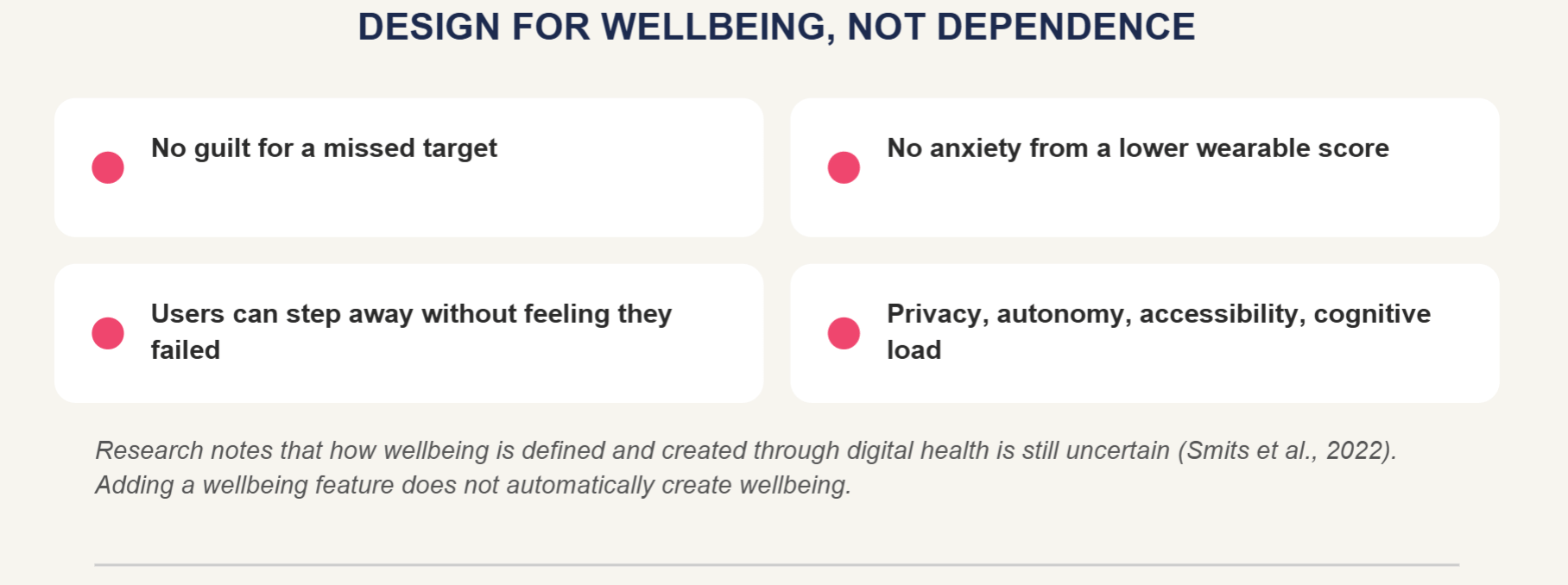
A person who misses a target should not feel guilty.
Someone should not become anxious because their wearable gives them a lower score.
A user should be able to step away from the technology without feeling that they are failing.
Digital health and wellbeing apps therefore require thoughtful design.
It means considering privacy, autonomy, accessibility, cognitive load, and emotional experience alongside technical performance.
Research has also highlighted that the relationship between technology and wellbeing is complex. A systematic review by Smits and colleagues (2022) found that there is still uncertainty about how wellbeing should be defined and created through digital health.
We should not assume that adding a wellbeing feature automatically creates wellbeing.
We need to ask whether it genuinely helps people.
From measuring people to understanding people
Healthcare technology gives us unprecedented opportunities.
Wearables can provide continuous information.
Artificial intelligence can identify patterns.
Digital platforms can make health information more accessible.
Remote monitoring can connect people with care outside traditional settings.
But behind every dataset is a person.
That person has relationships.
They have responsibilities.
They have fears.
They have hopes.
They have values.
They have a reason for wanting to become healthier.
PERMA provides one useful lens for remembering this.
It encourages us to ask whether our technology supports positive emotion, meaningful engagement, relationships, meaning, and accomplishment.
It also reminds us that wellbeing is multidimensional.
A person cannot always be reduced to a single health score.
Perhaps the future of digital health is therefore not simply about collecting more data.
It is about helping people make better sense of the data they already have.
It is about creating technology that supports reflection rather than anxiety, motivation rather than pressure, connection rather than isolation, and progress rather than perfection.
Ultimately, digital health and wellbeing should not be treated as two separate ideas.
The technology we create becomes part of people’s everyday lives.
So perhaps the question we should ask before building the next healthcare application is not simply:
“What can this technology measure?”
but:
“How might this technology help a person live a life that feels healthier, more connected and more meaningful?”
That is where technology begins to move beyond functionality.
It begins to support human flourishing.
References
- Butler, J., & Kern, M. L. (2016). The PERMA-Profiler: A brief multidimensional measure of flourishing. International Journal of Wellbeing, 6(3), 1–48. https://doi.org/10.5502/ijw.v6i3.526
- Seligman, M. E. P. (2011). Flourish: A visionary new understanding of happiness and well-being. Free Press. https://books.google.com/books/about/Flourish.html?id=IRsEngEACAAJ
- Smits, M., Kim, C. M., van Goor, H., & Ludden, G. D. S. (2022). From digital health to digital well-being: Systematic scoping review. Journal of Medical Internet Research, 24(4), e33787. https://doi.org/10.2196/33787
- Zaresani, A., & Scott, A. (2020). Does digital health technology improve physicians’ job satisfaction and work-life balance? A cross-sectional national survey and regression analysis using an instrumental variable. BMJ Open, 10(12), e041690. https://doi.org/10.1136/bmjopen-2020-041690