


When we talk about healthcare technology, we often focus on the technology itself.
Is the system usable? Is it reliable? Can clinicians adopt it? Does it reduce administrative work? Does it improve efficiency and support better care?
These are important questions. But there is another question that receives far less attention:
What about the people who build, implement and work with the technology?
Healthcare technology does not create itself. Behind every digital health platform, electronic health record, clinical information system or decision-support tool are people working under deadlines, technical constraints, organisational pressures and constantly changing requirements.
Some may feel that their work has genuine purpose and contributes to something important. Others may experience their work as fragmented, stressful or disconnected from its wider purpose.
This raises an interesting question: Is meaningful work in healthcare technology a crucial aspect?
Does Meaning in work matter for people working in healthcare technology?
Research in positive psychology and meaningful work suggests that it may.
What do we mean by meaning at work?
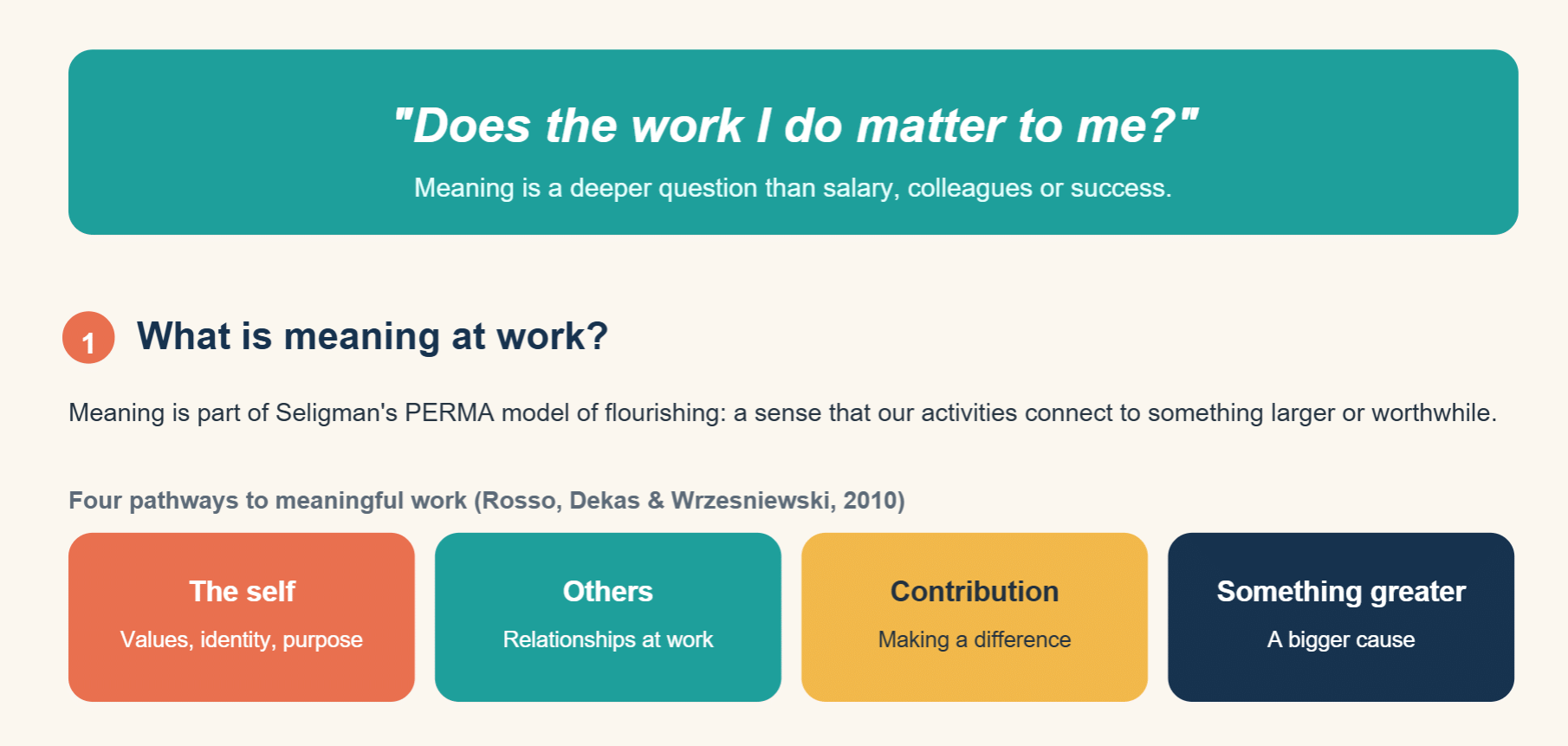
Meaning is an important part of Seligman’s PERMA framework for human flourishing. In this context, Meaning relates broadly to having a sense that our lives and activities connect to something larger or worthwhile (Seligman, 2011).
However, Meaning at work is more specific than simply enjoying a job.
Research on meaningful work examines whether people experience their work as significant, worthwhile, and connected to something they value. Rosso, Dekas and Wrzesniewski (2010) reviewed a wide body of research and showed that meaningfulness can arise through different pathways, including the self, relationships with others, contribution and a sense of something greater than the self.
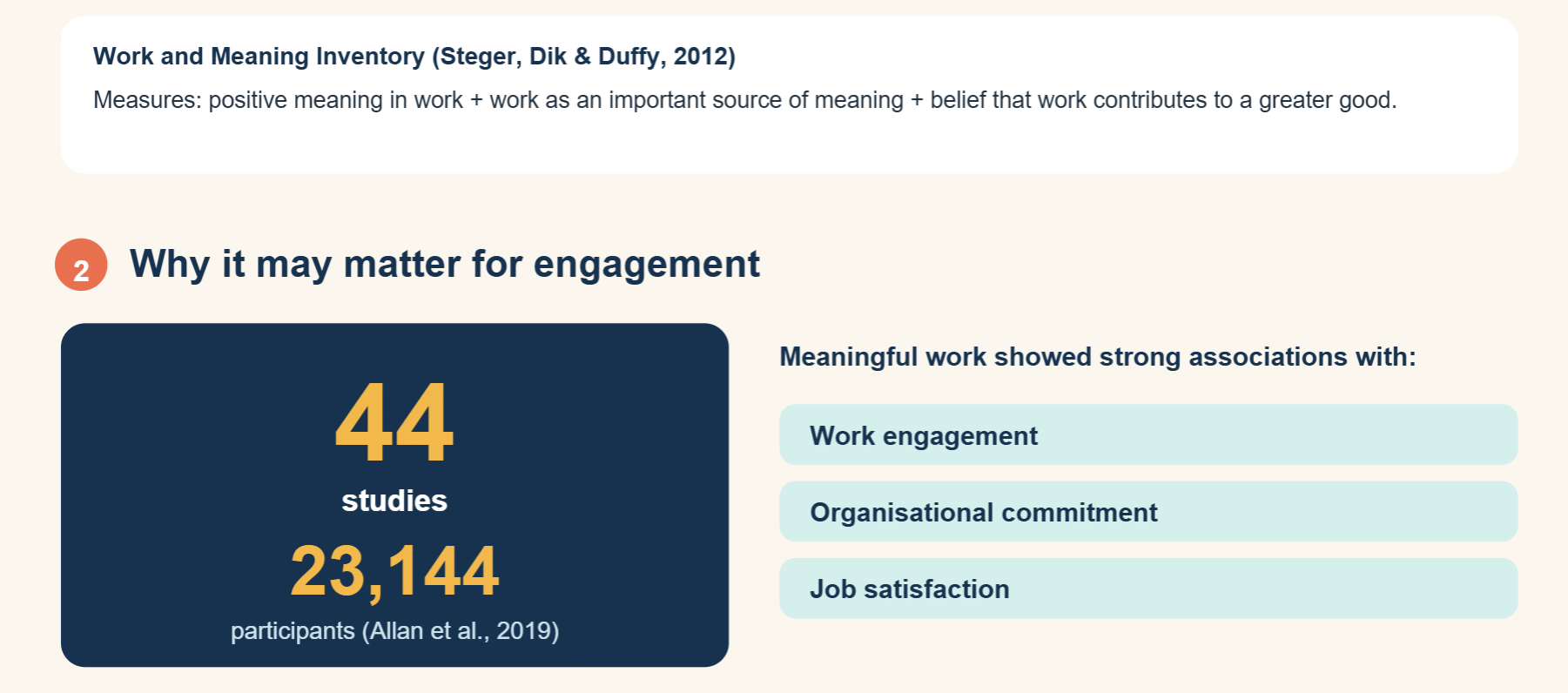
Steger, Dik, and Duffy (2012) subsequently developed the Work and Meaning Inventory (WAMI) to measure meaningful work. Their model includes experiencing positive meaning in work, seeing work as an important source of meaning, and believing that one’s work contributes to a greater good.
This distinction is important.
A person can be satisfied with a salary, enjoy their colleagues, or even feel successful, without necessarily experiencing a strong sense of Meaning in what they do.
Meaning asks a deeper question:
“Does the work I do matter to me?”
Why might Meaning matter for engagement?
One reason this question matters is its potential relationship with work engagement.
Engagement describes a positive work-related state involving energy, involvement, and dedication. Meaningful work research suggests that people who experience greater Meaning may also experience stronger engagement and other positive work outcomes.
One of the strongest pieces of evidence comes from Allan et al. (2019), whose meta-analysis examined 44 studies involving 23,144 participants. Meaningful work showed strong associations with work engagement, organisational commitment, and job satisfaction.
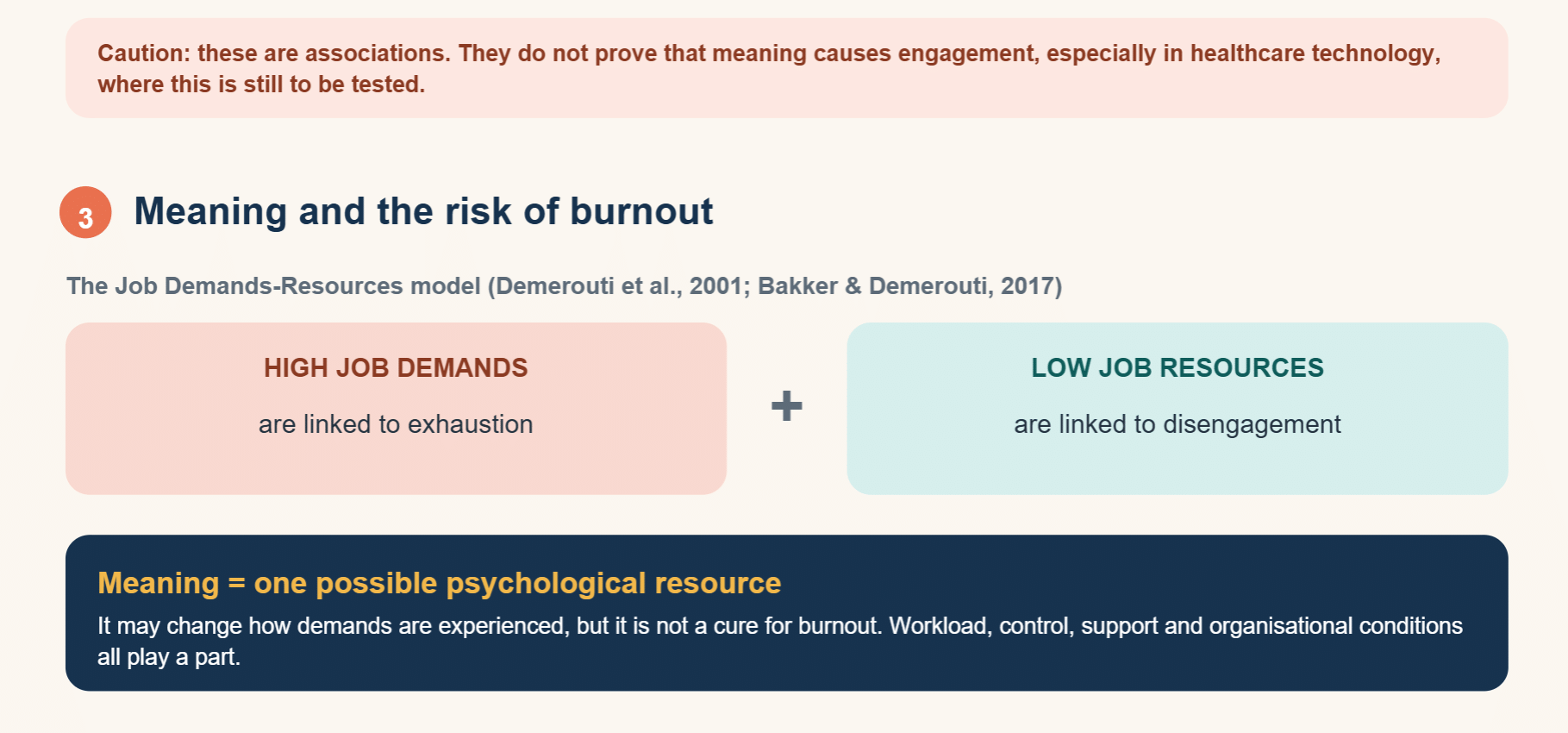
Importantly, these findings demonstrate associations, rather than proving that Meaning itself causes these outcomes.
This distinction matters particularly when applying the evidence to healthcare technology.
The existing literature does not tell us that Meaning automatically creates an engaged healthcare technology workforce.
It gives us a strong reason to investigate whether the relationship can also be observed in this specific professional population.
A fictional example: the software engineer who lost sight of the purpose
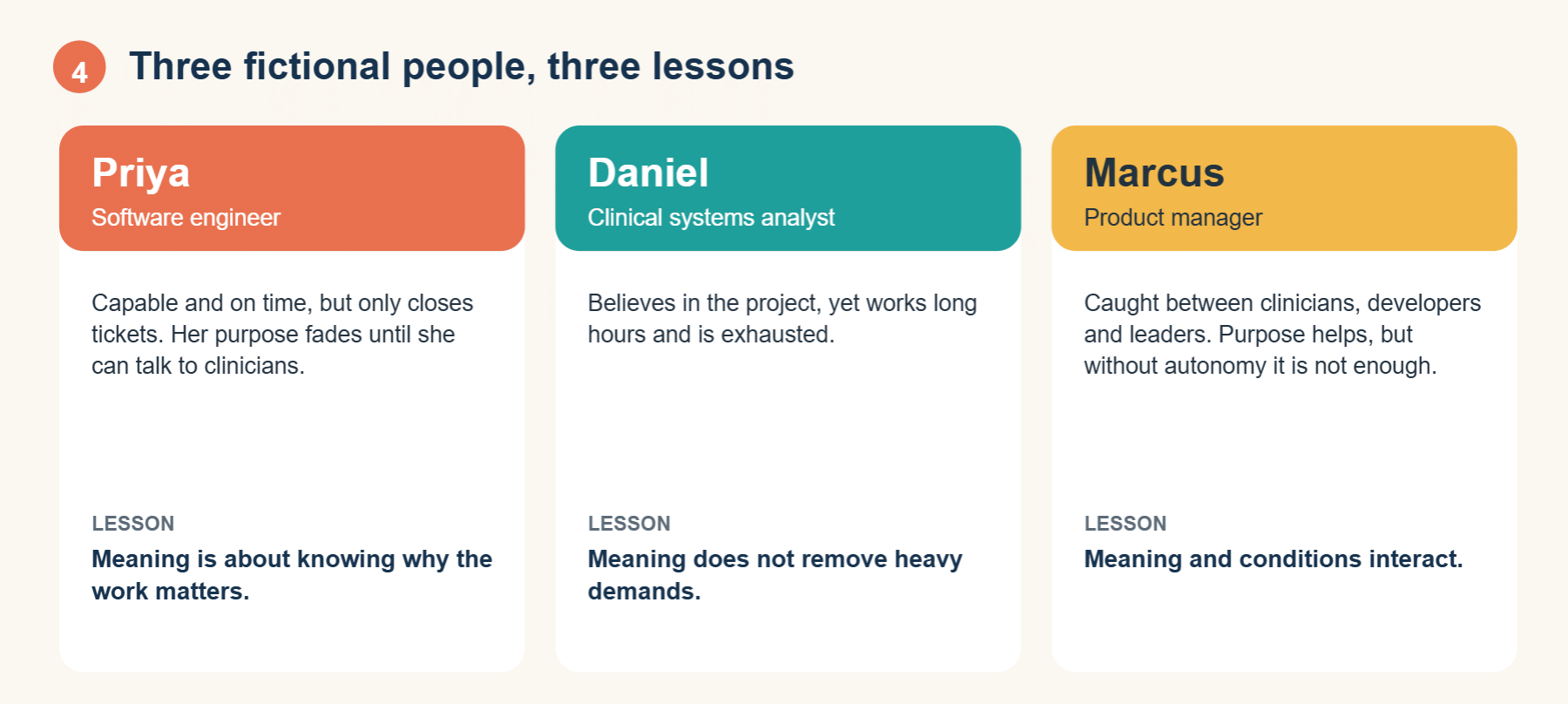
Consider Priya, a fictional software engineer working on an electronic health record system.
Priya is highly capable. She meets deadlines and solves difficult technical problems. Yet much of her working day involves fixing small technical issues and responding to change requests.
She rarely sees what happens after the system leaves her team.
Over time, she begins to feel that she is simply completing tickets rather than contributing to healthcare.
Her workload has not necessarily changed. Her salary has not changed. Her technical ability has not changed.
But her sense of purpose has.
Now imagine that her organisation gives her opportunities to speak directly with clinicians and understand how changes to the system affect patients and healthcare teams.
The work itself may still be demanding.
However, Priya can now see the connection between her technical decisions and something she considers worthwhile.
This fictional example illustrates an important distinction:
Meaning is not necessarily about making work easier. It may be about helping people understand why the work matters.
Meaning and the risk of burnout
There is another side to the story.
Technology professionals working in healthcare can face considerable demands: complex systems, changing requirements, competing priorities, implementation challenges, regulatory expectations and the consequences of getting things wrong in environments where technology can affect patient care.
This makes burnout an important part of the conversation.
The Job Demands–Resources (JD-R) model provides a useful theoretical lens. Demerouti et al. (2001) proposed that working conditions can broadly be understood in terms of job demands and job resources. High demands are associated with exhaustion, while insufficient resources are associated with disengagement.
Bakker and Demerouti (2017) subsequently developed the theory further, showing how the JD-R framework can help explain both the health-impairment process and the motivational process at work.
From this perspective, Meaning can be considered a potentially important psychological resource.
A person who feels that their work contributes to something worthwhile may experience their demands differently from someone who sees their work as meaningless or disconnected from any valued purpose.
However, Meaning should not be presented as a simple cure for burnout.
Burnout is influenced by multiple factors, including workload, job control, support, organisational conditions and the wider working environment.
Meaning is one possible part of that much larger picture.
A fictional example: meaningful work does not remove heavy demands
Consider Daniel, a fictional clinical systems analyst helping a hospital implement a new digital documentation system.
Daniel strongly believes in the purpose of the project. He wants clinicians to spend less time searching for information and more time with patients.
Yet he is also working long hours, dealing with competing priorities and responding to frequent implementation problems.
His work is highly meaningful to him, but he is becoming exhausted.
This example matters because it prevents us from making an overly simplistic argument.
Meaning does not make excessive demands disappear.
Someone can find their work deeply meaningful and still experience burnout when demands are too high and resources are inadequate.
The lesson is therefore not:
“Give people purpose and burnout will disappear.”
It is:
“Meaning may be one psychological resource within a much larger system of demands and resources.”
That is much closer to the logic of the JD-R model.
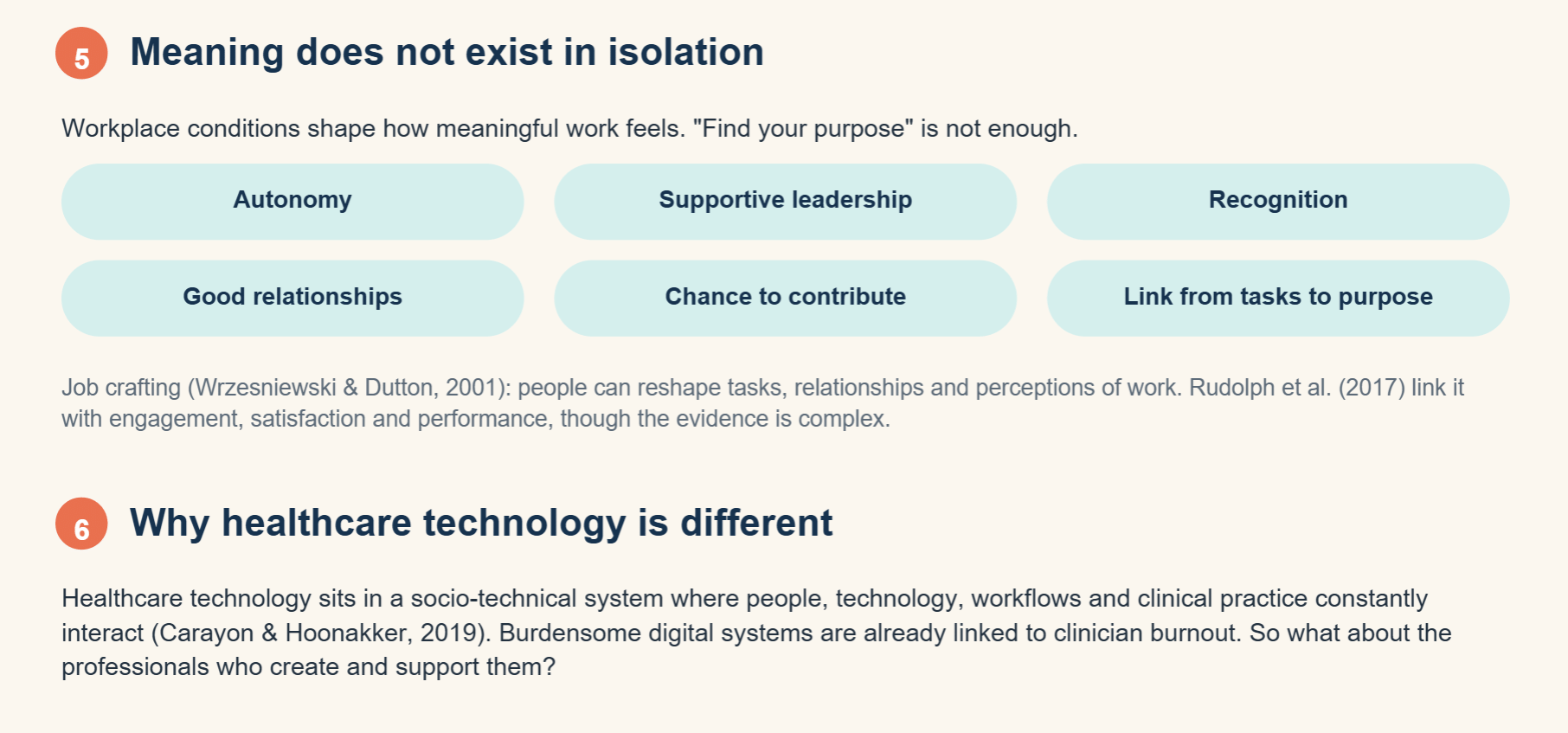
Meaning does not exist in isolation
An important lesson from the literature is that meaningful work is not created entirely inside the individual.
The workplace itself matters.
Leadership, culture, recognition, autonomy, relationships and opportunities to shape one’s work can all influence how people experience their jobs.
This is reflected in research on job crafting. Wrzesniewski and Dutton (2001) described how employees can actively alter aspects of their tasks, relationships and perceptions of their work, potentially changing the meaning they derive from it.
A later meta-analysis by Rudolph et al. (2017) found relationships between job crafting and outcomes including engagement, satisfaction and performance, while also highlighting the complexity of the evidence.
The implication is important for healthcare organisations.
If organisations want employees to experience meaningful work, simply telling people to “find their purpose” may not be enough.
The organisation may also need to consider whether people have autonomy, supportive leadership, opportunities to contribute, recognition and a clear connection between everyday tasks and wider organisational purpose.
Why this matters specifically in healthcare technology
Healthcare technology is different from many other technology environments because it operates within a wider socio-technical system.
People, technology, workflows, organisations and clinical practice interact continuously.
Carayon and Hoonakker (2019) emphasised the importance of human factors and usability for health information technology, showing why successful digital health cannot be understood simply by looking at software features in isolation.
Organisational context matters too. Research examining health information technology implementation has highlighted the importance of organisational culture and context.
At the same time, there is evidence that poorly designed or burdensome digital systems can affect healthcare professionals. Research on electronic health record use, for example, has identified an important relationship between digital-system burden and clinician burnout.
This creates an important chain of thought.
We already recognise that technology can affect healthcare professionals.
But what about the professionals creating and supporting the technology itself?
A fictional example: the product manager between two worlds
Consider Marcus, a fictional healthcare technology product manager.
His job sits between software developers, clinicians, senior leaders and patients’ needs.
He spends much of his time translating competing requirements.
Clinicians want fewer clicks.
Developers need technically realistic specifications.
Senior leaders are concerned about cost and implementation timelines.
Marcus sometimes feels caught between everyone.
However, he also knows why the work matters. A successful product could remove unnecessary friction from clinical practice.
This sense of contribution may help sustain his motivation.
But if the organisation gives him no autonomy, little support and unrealistic deadlines, Meaning alone may not be enough.
The fictional case therefore illustrates a broader point:
Meaning and organisational conditions are likely to interact rather than operate independently.
From better technology to better conditions for the people who build it
This is where the question becomes broader.
It would be too strong to claim that Meaning causes better healthcare technology. The evidence does not establish that.
A more responsible question is whether the psychological experience of people working in healthcare technology may have implications for the wider sustainability of digital health systems.
If people who build healthcare technology experience meaningful work, feel engaged, have appropriate resources and work within supportive organisational cultures, could these conditions contribute to healthier ways of working?
Could that eventually influence collaboration, decision-making, resilience, retention, innovation or the quality of technology development?
These are questions for further research.
The important point is that these possibilities should be investigated rather than assumed.
A more human-centred view of digital health
The future of healthcare technology is often discussed in terms of artificial intelligence, interoperability, automation, data and digital transformation.
All of these developments matter.
But healthcare technology remains fundamentally human.
People decide what problems technology should solve.
People design workflows.
People interpret requirements.
People make trade-offs.
People test systems.
People respond when systems fail.
People maintain and improve technology long after implementation.
For that reason, the psychological wellbeing and experience of the technology workforce should not be treated as an unrelated issue.
Meaningful work is not simply about making people feel happier.
It is about understanding whether people experience their contribution as worthwhile and connected to something that matters.
For healthcare technology professionals, that question may be particularly significant.
The bigger question
My doctoral research grew from this simple idea:
Healthcare technology is built by people, so perhaps we need to pay more attention to the people behind the technology.
The evidence already tells us that meaningful work is associated with important outcomes such as engagement and job satisfaction.
The JD-R framework provides a useful explanation for understanding the relationship between workplace demands, resources, engagement and burnout.
Human-factors research shows that healthcare technology must be understood within the wider system of people, processes and organisations.
What remains particularly interesting is the intersection of these areas.
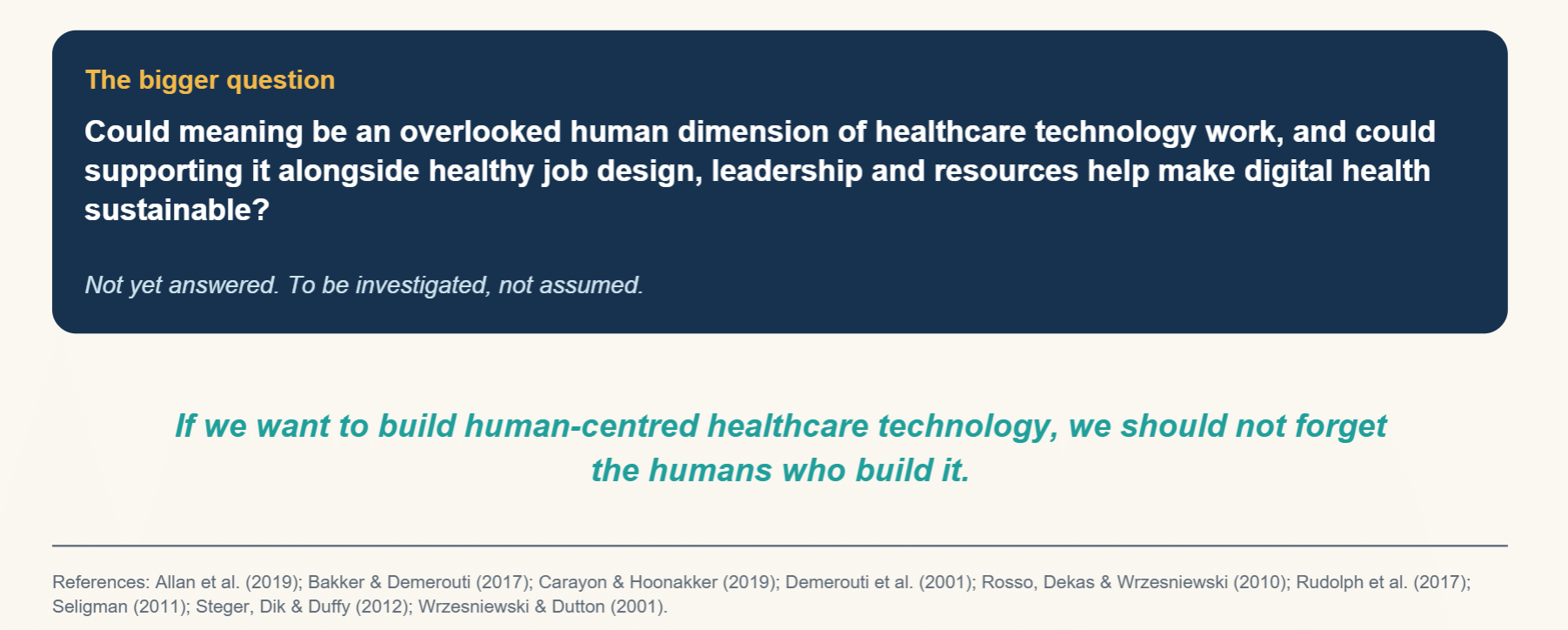
Could Meaning be an overlooked human dimension of healthcare technology work?
Could supporting Meaning, alongside healthy job design, leadership, autonomy and organisational resources, become part of a broader approach to sustainable digital health?
We do not yet have all the answers.
But perhaps that is precisely the point.
If we want to build human-centred healthcare technology, we should not forget the humans who build it.
References
- Allan, B. A., Batz-Barbarich, C., Sterling, H. M., & Tay, L. (2019). Outcomes of meaningful work: A meta-analysis. Journal of Management Studies, 56(3), 500–528. doi:10.1111/joms.12406
- Bakker, A. B., & Demerouti, E. (2017). Job demands-resources theory: Taking stock and looking forward. Journal of Occupational Health Psychology, 22(3), 273–285. doi:10.1037/ocp0000056
- Carayon, P., & Hoonakker, P. (2019). Human factors and usability for health information technology: Old and new challenges. Yearbook of Medical Informatics, 28(1), 71–77. doi:10.1055/s-0039-1677907
- Demerouti, E., Nachreiner, F., Bakker, A. B., & Schaufeli, W. B. (2001). The job demands-resources model of burnout. Journal of Applied Psychology, 86(3), 499–512. doi:10.1037/0021-9010.86.3.499
- Rosso, B. D., Dekas, K. H., & Wrzesniewski, A. (2010). On the meaning of work: A theoretical integration and review. Research in Organizational Behavior, 30, 91–127. doi:10.1016/j.riob.2010.09.001
- Rudolph, C. W., Katz, I. M., Lavigne, K. N., & Zacher, H. (2017). Job crafting: A meta-analysis of relationships with individual differences, job characteristics, and work outcomes. Journal of Vocational Behavior, 102, 112–138. doi:10.1016/j.jvb.2017.05.008
- Seligman, M. E. P. (2011). Flourish: A visionary new understanding of happiness and well-being. Free Press.
- Steger, M. F., Dik, B. J., & Duffy, R. D. (2012). Measuring meaningful work: The Work and Meaning Inventory (WAMI). Journal of Career Assessment, 20(3), 322–337. doi:10.1177/1069072711436160
- Wrzesniewski, A., & Dutton, J. E. (2001). Crafting a job: Revisioning employees as active crafters of their work. Academy of Management Review, 26(2), 179–201. doi:10.5465/amr.2001.4378011