

A humanistic look at how small daily habits can change the way we think, feel and live.
Introduction
There is a voice that lives inside every one of us. On a good day it sounds like a kind friend. On a hard day it sounds like a harsh critic, whispering, “You are not good enough,” or “Something will go wrong again.”
If you know that voice well, you are not broken, and you are not alone. Almost everyone carries it. The trouble begins when we believe it without question and let it decide how we feel, how we sleep and how we treat the people we love.
This article tells the story of one woman who learned to answer that voice with gentleness. Her journey shows how positive psychology, the science of what helps people thrive, can turn a restless mind into a calmer home. Her name and details are changed, but her struggles will feel familiar to many of us.
What Is Positive Psychology?
Positive psychology began in the late 1990s, led by psychologist Martin Seligman and his colleagues (Seligman & Csikszentmihalyi, 2000). For many years, psychology mostly asked, “What is wrong with people?” Seligman wanted to ask a warmer question too: “What helps people live well?”
The answers are surprisingly human. Gratitude. Close relationships. Using our strengths. Finding meaning in what we do. Treating ourselves with kindness. These are not luxuries. Research suggests that simple exercises built on them can modestly improve well-being and ease low mood (Seligman et al., 2005; Bolier et al., 2013).
Positive psychology does not ask you to smile through pain, and it never says that sadness is a failure. It simply reminds us that, alongside our troubles, there is something good in us worth growing.
Meera’s Story
Meera is 34 and works as a project coordinator in a busy city. Her colleagues describe her as thoughtful and dependable. She is the person who remembers birthdays and stays late to help.
But inside, Meera was tired in a way that sleep could not fix. Her mind always expected the worst. A short email from her manager meant, “I have done something wrong.” A friend who was slow to reply meant, “They have forgotten me.” At night she replayed every small mistake, like a film she could not switch off.
One evening, she sat in her kitchen with a cold cup of tea and realised she could not remember the last time she felt truly at ease. She was not in crisis. She was simply worn out from being so hard on herself. That night, she decided to ask for help.
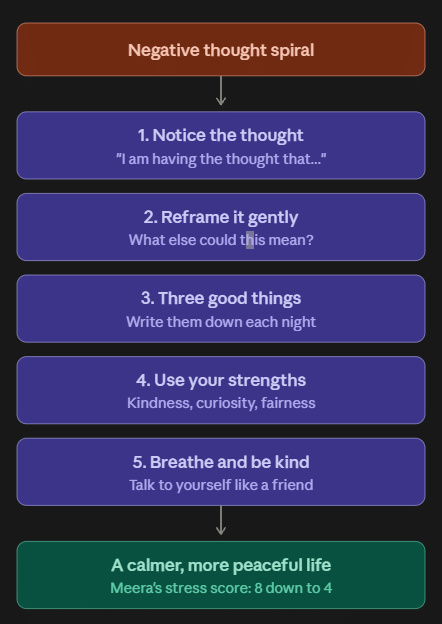
She began meeting a counsellor who used positive psychology. Over eight weeks, they practised five small habits. None of them was dramatic. Together, they changed her days.
Learning to notice
Her counsellor’s first gift was simple: “You are not your thoughts. You are the one hearing them.” Meera began to say, “I am having the thought that I will fail.” Those few words made a little room inside her to breathe.
It felt strange at first. Yet after two weeks she could catch a spiral within a minute, instead of being carried away by it for an hour.
Asking kinder questions
Next, she learned to question her thoughts the way a caring friend would. Is this truly certain? What else could be happening? What would I say to someone I love who felt this way?
Often the answers were softer. Her manager was probably just busy. The short email was simply short. Meera was not lying to herself. She was choosing a fairer story.
Collecting small joys
Each night, Meera wrote down three good things from her day. A warm cup of tea. A colleague’s laugh. Ten quiet minutes in the sun at lunchtime.
Our minds hold on to worries more tightly than to joys, an old survival habit. In a well-known online study, people who wrote down three good things each night felt happier for up to six months (Seligman et al., 2005). This little ritual taught her to notice the good as it happened. “I started seeing small gifts everywhere,” she said later. “They were always there. I just was not looking.”
Remembering who she is
A short strengths survey showed Meera’s top qualities: kindness, curiosity and fairness. She had spent years listing her flaws. Now, for the first time, she saw her gifts.
She began to mentor a new colleague and joined a weekend pottery class. With her hands in the clay, she felt a quiet sense of purpose that she had missed for years.
Speaking to herself with care
Finally, Meera added ten minutes of slow breathing each morning and one new rule: speak to yourself as you would to a dear friend, an approach psychologists call self-compassion (Neff, 2003). After a mistake, instead of “You are so careless,” she whispered, “That was hard. You are learning. It is okay.”
She admits that the first time she said it, her eyes filled with tears. Nobody had spoken to her so gently in a long time, least of all herself.
What Changed
The change was slow and quiet, like a tide coming in. After eight weeks, Meera noticed that:
- Her worries came less often and lost much of their sting.
- She fell asleep faster and woke up feeling lighter.
- She became more patient and present with family and friends.
- Mistakes at work no longer ruined her whole evening.
- Her stress, on a scale of one to ten, fell from about 8 to about 4.
Her thoughts did not vanish, and she still has hard days. But when a worry arrives, she can say, “Thank you, mind. I know you are trying to protect me, but I am safe right now.” Then she lets it pass. That is the real gift of positive psychology: not a life without storms, but a steadier heart inside them.
Why It Works
These habits work because they fit how people actually feel and think.
They train our attention. What we look at again and again grows stronger, so noticing good things balances our natural lean toward worry.
They create space. When we watch a thought instead of obeying it, it loses its power over us.
They soften us. Harsh self-talk keeps the body tense. Kindness lets it rest.
They build hope. Each tiny success whispers, “I can do this,” and that belief carries us forward.
Try It Yourself
You do not need to change your whole life in a week. Choose one small step and be gentle with yourself.
- Notice: When a harsh thought appears, say, “I am having the thought that…”
- Ask: Is this fully true? What would I tell a friend?
- Collect: Write down three good things before bed.
- Remember: Use one of your strengths today, however small.
- Breathe: Take five slow breaths and speak to yourself kindly.
If you miss a day, that is fine. Begin again without blame. Healing is never a straight line.
A Gentle Note
Positive psychology is a caring companion, but it is not a replacement for professional help. If your thoughts feel heavy, last for weeks or make you feel unsafe, please talk to a doctor, a counsellor or someone you trust. Reaching out is not weakness. It is courage.
Conclusion
Meera did not become a different person. She became a kinder friend to the person she already was. Peace, she discovered, is not a finish line we cross when life is perfect. It is something we practise, one breath and one gentle thought at a time.
You may not control everything that happens to you, but you can choose how you speak to yourself along the way. Start today with one small habit, and let calm grow slowly. You deserve that kindness.
References
- Bolier, L., Haverman, M., Westerhof, G. J., Riper, H., Smit, F., & Bohlmeijer, E. (2013). Positive psychology interventions: A meta-analysis of randomized controlled studies. BMC Public Health, 13, 119. https://doi.org/10.1186/1471-2458-13-119
- Neff, K. D. (2003). Self-compassion: An alternative conceptualization of a healthy attitude toward oneself. Self and Identity, 2(2), 85–101. https://doi.org/10.1080/15298860309032
- Seligman, M. E. P., & Csikszentmihalyi, M. (2000). Positive psychology: An introduction. American Psychologist, 55(1), 5–14. https://doi.org/10.1037/0003-066X.55.1.5
- Seligman, M. E. P., Steen, T. A., Park, N., & Peterson, C. (2005). Positive psychology progress: Empirical validation of interventions. American Psychologist, 60(5), 410–421. https://doi.org/10.1037/0003-066X.60.5.410