

Introduction
Remote Patient Monitoring (RPM) has become a significant feature in today’s health care by allowing clinical practitioners to monitor patients’ vital signs, symptoms, and behaviour remotely, without being located in the hospital or any health institution. RPM is revolutionising medical practices, from managing chronic conditions to post-acute care or mental health assistance.
Fundamentally, a simple concept lies behind this transition: rather than waiting for periodic tests at doctors’ offices and hospitals, health care can be continuous and personalized based on plentiful data. As the Remote Patient Monitoring Market expands around the world, advances in connected health make this concept absolutely achievable and relevant in terms of overall wellness.
The Scale of the Shift: RPM Market Growth
The RPM industry has been flourishing quickly due to the aging population, chronic illness incidence, technological innovations in sensor and communication fields, and the growing acceptance of remote healthcare.
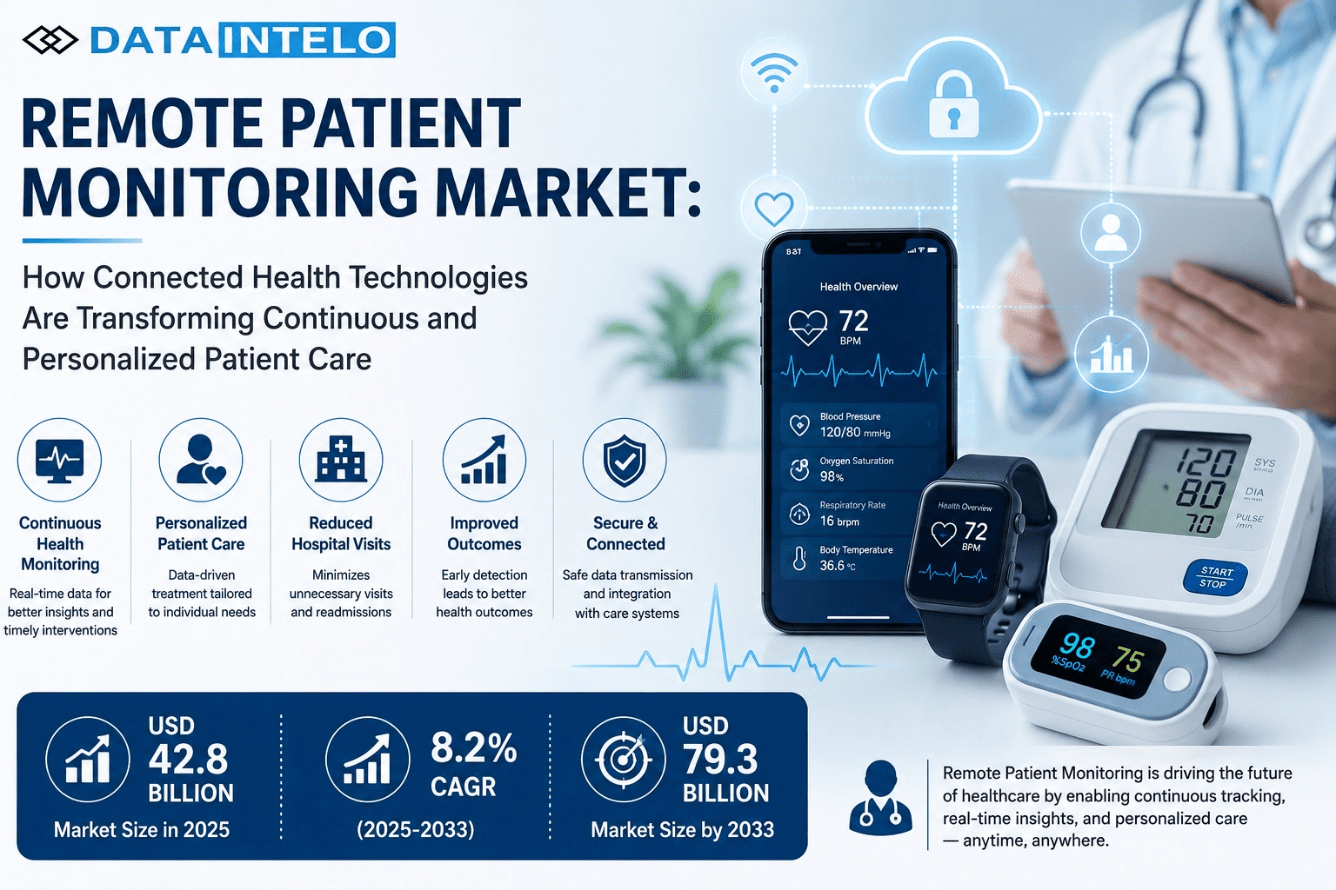
According to DataIntelo, the Remote Patient Monitoring industry is valued at USD 42.8 billion in 2025 and will reach USD 79.3 billion by 2033 with a CAGR of approximately 8.2%. Certain markets are projected to expand with even greater speed, as CAGRs of between 18-21% can be expected in particular market segments, such as RPM software, connectivity, and device markets.
The development surge in this field does not only mean that an increasing number of devices are released. What is implied by the evolution is the emergence of integrated ecosystems that allow for smooth communication of data produced by wearables, at-home monitoring devices, and mobile applications with clinical procedures, which allows for greater early interventions and enhances the engagement of physicians and patients.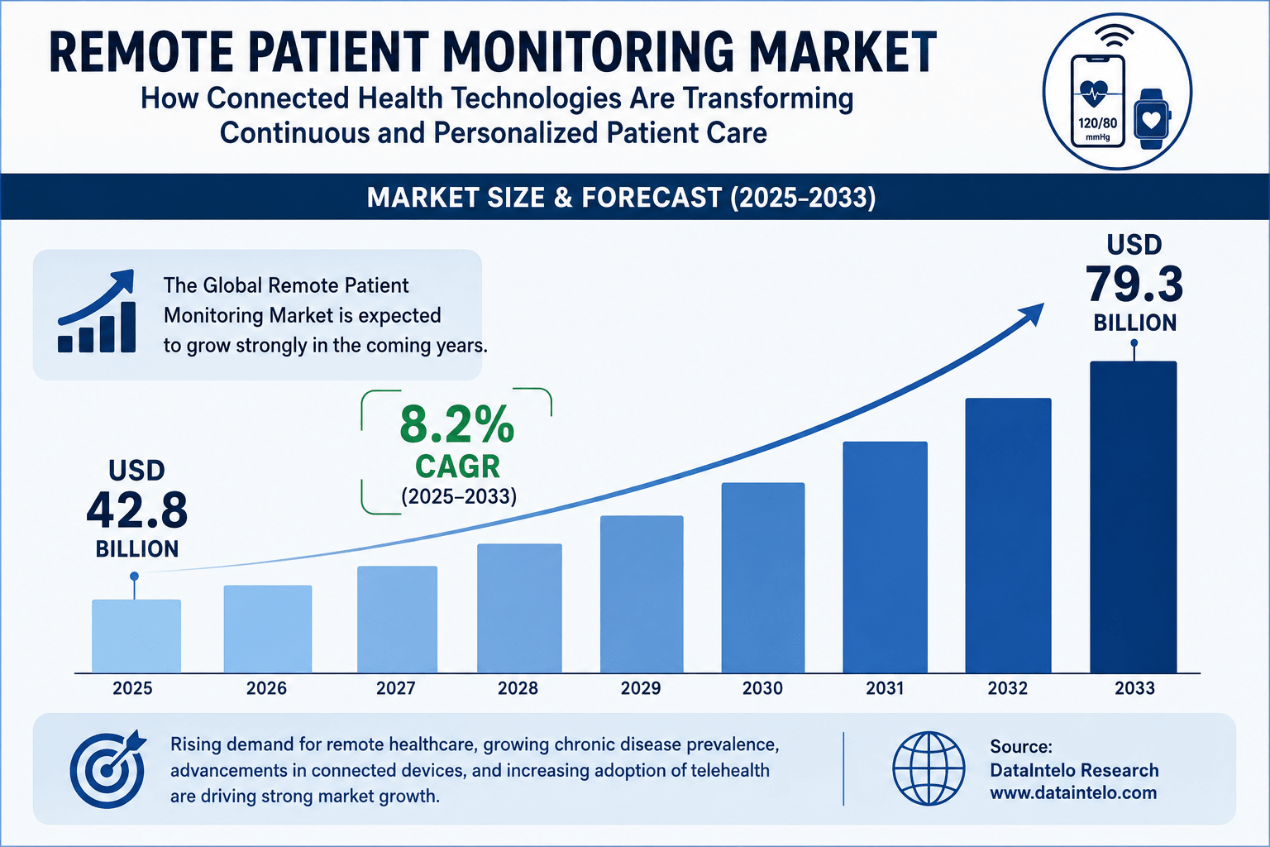
What Is Remote Patient Monitoring?
Remote Patient Monitoring is when digital technologies are employed to collect and transmit a patient’s health and medical information to healthcare professionals securely.
The usual applications are as follows:
Keeping an eye on important indicators, including blood pressure, heart rate, oxygen level, weight, sugar level, etc.
- Keeping watch on important symptoms and how they take their medications and follow their lifestyle
- Assisting with chronic conditions like diabetes, blood pressure, heart issues and COPD
- RPM is delivered through exclusive health gadgets, consumer wearables, mobile apps, and comprehensive telehealth platforms.
- How RPM makes personal, patient-oriented care available to a wider circle of people.
RPM can be provided using dedicated medical devices, wearable products, smartphones and applications, as well as through virtual health platforms.
Expansion of Remote Patient Monitoring to Provide Personalized, Patient-Centered Healthcare
- Continuous, Real-World Data: No More Snapshots
The typical method of taking care of patients involves having them come for clinic visits, and it is only then that the doctors get to know how the patient is doing. RPM changes the game and makes the whole process continuous at the patient’s home.
Doctors can now use RPM to:
- Detect warnings in advance (e.g., when the patient’s hypertension worsens or they gain weight).
- Adjust the treatment process based on ongoing monitoring as opposed to some measurements during office visits.
- Reduce the number of unnecessary office visits, as well as boost their efficiency.
Such constant observation only serves to help the doctor offer personalized treatment and makes the patients feel more cared for when they are not in the office.
- Better Support for Chronic Conditions
Chronic illnesses make up a large chunk of the costs of healthcare and disability worldwide. Remote Patient Monitoring (RPM) helps in:
- Regular remote checkups without visiting a hospital
- Automatic alerts about abnormal readings
- Specific protocols for diabetes, hypertension, heart conditions, and respiratory illnesses
Patients get a better understanding in terms of the consequences of their actions on health, making them more self-aware.
- Enhanced Mental Health and Well-Being
RPM may be associated with physical health. It contributes to mental health in various ways, including:
- Tracking mood and symptoms using different platforms as part of care
- Conducting therapy remotely in conjunction with self-tracking
- Recognizing the signs of potential recurrence of depression, anxiety, etc.
From the PERMA approach (Positive Emotions, Engagement, Relationships, Meaning and Achievements), effective RPM systems can:
- Provide prompt positive feedback and support (Positive Emotions)
- Motivate patients in self-management (Engagement)
- Strengthen relationships with patients through continuous constructive communication (Relationships)
- Give patients tools to help them reach their long-term health goals step by step (Meaning)
- Mark achievements and successes (Accomplishments)
This makes RPM not just a clinical tool, but a potential contributor to psychological well-being when implemented thoughtfully.
- Greater Equity and Convenience
RPM is used to address problems that arise because of geographical constraints as well as mobility and timeliness. It allows:
- Patients living in rural and isolated areas to access their health care provider.
- Older patients or patients with mobility issues to get the needed consultation.
- Caregivers and people with demanding jobs to discuss their health issues with health care professionals.
- Patients going out of the hospital to receive monitoring and supervision without being admitted to the hospital.
RPM makes health care more available to patients, providing them with a patient-centered approach to health care as well as reducing the stress caused by traveling to clinics frequently.
Market Dynamics: What’s Driving RPM Growth?
The growth of the Remote Patient Monitoring market is influenced by significant structural changes.
Growing impact of chronic illnesses
Chronic illnesses like diabetes, heart diseases, respiratory diseases, etc. result in the necessity of continuous therapies. The use of Remote Patient Monitoring allows health care facilities to achieve the following objectives:
- While not requiring patients to be physically present, they can monitor more patients
- Conduct interventions at early stages to prevent complications and hospitalizations
- Tailor their operation to the needs of the value-based payment model, making it focus on outcomes instead of the number of services delivered.
For instance, the existence of remote monitoring for patients suffering from cardiac diseases will lower the rate of re-admissions by 15% to 25%, and the Diabetes Remote Monitoring™ solutions will improve the patients’ HbA1c levels and adherence to medication.
Advances in Technology
The development in sensors, connectivity, and artificial intelligence makes the process more accurate, affordable, and scalable.
Some examples of these advances are:
- Adoption of wearable and patch devices for continuous monitoring of vital signs
- Implementation of connected blood sugar meters, blood pressure monitors, and scales
- Use of AI-based analytics to identify dangerous trends and suggest methods of assisting important people
- Integrating the technology with electronic health records (EHR).
Policy and Reimbursement Support
Several countries, especially those on the North American continent and some European nations, have enhanced their coverage for remote monitoring of patients.
Below are some examples of the recent developments made by some countries:
- RPM billing codes dedicated to chronic care management
- Coverage of remote patient monitoring devices and services
- Support for hybrid healthcare services
Providing transparent reimbursement procedures will ensure that payers find remote patient monitoring profitable and patients enjoy having their health monitored.
Patient Expectations and Behavior Change
At last, patients seek digital methods that fit their daily lives. Therefore, remote monitoring devices need to have such features as:
- Ease of use.
- Compatibility with mobile devices and wearables
- Ability to deliver feedback and educational information to patients.
At the same time, linking positive psychology theory to these devices can be justified by their creation of independence, effectiveness, and connectedness.
Segment Insights: Where the Market Is Heading
By Component
- Devices and Sensors: This segment remains the dominant element of the industry, encompassing an array of wearables, patch monitors, and smart home solutions, with microtechnology, battery life, and multi-parameter sensing contributing to their uptake.
- Software and Platforms: Health IT software is rapidly evolving as it integrates health risk stratification, clinical management, and EHR tools that enable patient compliance.
- Services: Critical IoT services such as system setup, hardware training, and clinical management services are essential as healthcare organizations expand their RPM services.
By Application
Management of Chronic Conditions: The ATP programs mostly include diabetes, hypertension, heart failure, and COPD, with clear clinical and financial gains.
- Care during the Post-Acute and Post-Discharge Stages: RPM can be used to reduce the rates of re-admission and recovery post-hospitalization and surgical procedures.
- Mental and Behavioral Health: Mood monitoring, digital medicine, and remote therapeutic consultations have helped expand the reach of RPM in various new fields.
- Senior Care: RPM technologies like fall sensors, telemonitoring, and medication management devices can be beneficial for older adults at home
By Care Setting
- Home Care: This is the fastest-growing setting since monitoring and some treatments are being done at home.
- Hospitals and Health Systems: By using RPM, service providers can extend care past discharge and monitor at-risk patients.
- Long-Term Care Facilities: RPM is improving monitoring capabilities and lowering hospital transfers.
- Virtual-First and Hybrid Clinics: RPM is embedded in the care model rather than being an addition.
Regional Outlook
Adoption of RPM varies by region, reflecting differences in infrastructure, policy, and healthcare models.
Presently, North America dominates in the size and complexity of the market with advanced reimbursement structures, extensive use of connected devices, and developed virtual care systems. The U.S. itself accounts for a sizable portion of world revenue in RPM as a result of support for remote monitoring codes from Medicare and private payers
Europe is a prominent and expanding marketplace, fueled by the country-specific digital health systems, cross-border telemedicine initiatives, and amplified virtual primary healthcare. Nations like Germany, the UK, France, and the Nordic countries are witnessing rapid adoption of RPM in chronic care and post-acute care.
Asia Pacific is developing into the region with the highest growth rate due to:
- High and aging populations
- Quick integration of smartphones and the internet
- Government programs supporting digital health care
- Development of private RPM and telehealth systems.
For example, the countries of China, India, Japan, and Australia pour a lot of money into remote care infrastructure, making this region an important contributor to the evolution of the global RPM market.
Latin America, the Middle East, and Africa are considered low-level markets but have great potential in the long term, with mobile health and public-private partnerships gaining traction in these regions.
RPM and the PERMA Model: Creating a Perfect Match
For an organization whose mission is based on integrated health and wellness practices, RPM is a technological trend that has considerable potential in providing more continuous, personalized, and psychological care.
The PERMA model consists of five integral components:
PERMA model has five essential elements, which include Positive Emotions, Engagement, Relationships, Meaning, and Accomplishments:
- Positive Emotions: Positive emotions come from prompt feedback, motivation, and proper planning that shows how improvement will enhance the patients’ morale and hope for people suffering from chronic illness.
- Engagement: Monitoring one’s actions and setting goals make the patient take an active part in the therapy process.
- Relationships: Regular remote follow-up visits create a strong relationship with the patient and caregiver and reduce any kind of loneliness.
- Meaning: Relating everyday activities such as walking, taking medicine, and monitoring blood sugar levels to health and personal goals in life.
- Success: Attaining objectives such as achieving high levels, going through the process, obtaining the readership responses, and reducing symptoms boosts self-confidence and motivation.
With RPMs based on these principles, these programs become more than just “monitoring” and become a part of a bigger approach towards well-being.
Challenges and Considerations
RPM must face several hurdles despite a strong impetus to achieve its true potential.
- Digital Gap: Not all patients have access to a stable Internet connection and the enabled devices, nor are they capable of using the technology correctly.
- Workflow Integration: RPM data need to be integrated into the healthcare workflow to prevent extra work for practitioners.
- Data Safety: Healthcare data exchange raises concerns regarding user consent, cybersecurity, and governance.
- Equity and Access: Delivering RPM services in such a way that they do not exacerbate the health divide.
- Sustainable Payment: Clear long-term reimbursement mechanisms need to be established.
The resolution of these challenges will require cooperation from providers, payers, regulators, and technology providers. It will also involve adopting a user-centered design approach that takes into account the psychological experience of using such platforms as well as clinical and operational considerations.
Opportunities on the Horizon
The worldwide RPM market is booming and offers huge growth opportunities in several areas:
- Emerging Markets: Large populations in Asia, Africa, and Latin America, coupled with the increasing use of smartphones and neglected chronic care problems.
- Specialty Verticals: The fast emergence of telerehabilitation, teleophthalmology, telenursing, and behavioral telehealth.
- Personalization Powered by AI: Application of predictive analytics, risk scoring, and personalized nudges in making RPM a more proactive method of delivering care.
- Expansion of Home Care Services: More diagnostic tests, infusion therapy, and some types of treatment are moving to patients’ homes with the help of RPM.
- Integration with Value-Based Care: The business model for RPM is perfectly aligned with capitated, bundled, and outcomes-based payment models.
Any company that invests upfront in building scalable RPM technology, user-centered design, and access will benefit.
The Road Ahead: Toward Integrated, Person-Centered RPM
There are various changes that the RPM system will undergo over the next ten years:
- Integrating with virtual care applications. There is seamless integration of monitoring, communication, and video call systems.
- Artificial intelligence for providing personalized messages, data, and recommendations.
- More home care services will be available, making it possible to monitor and treat patients continuously.
- Equity as the topmost priority. Programs and devices will work towards reducing the inequities in health care among individuals from different communities.
As a result, RPM will be perceived less as a collection of gadgets and software and more as a means of providing ongoing personalized care that improves clinical outcomes and mental health.
Conclusion
Remote Patient Monitoring is one of the important aspects of the transition towards modern healthcare.
Organizations are expected to have good results in improving clinical outcomes for patients if they use RPM systems created in a user-friendly way and pay attention to their equitable and psychological aspects.
Reference: https://dataintelo.com/report/remote-monitoring-market